The future of nematode control: Scouting insights + Trefinti

Control recommendations
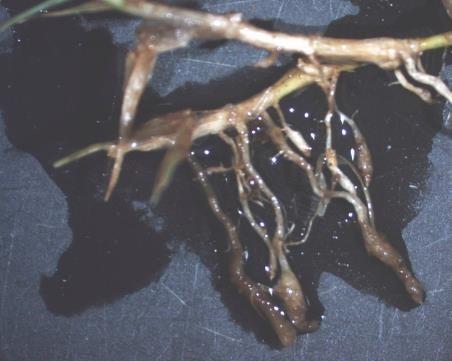
Nematodes are often overlooked as pests in turfgrasses. The above-ground symptoms are extremely variable and are often misdiagnosed as disease or other stresses. If you have areas that are constantly weak or susceptible to stress, nematodes may be a contributing factor.
The first step to diagnosing a nematode problem is to collect and send a soil sample to a laboratory for analysis.
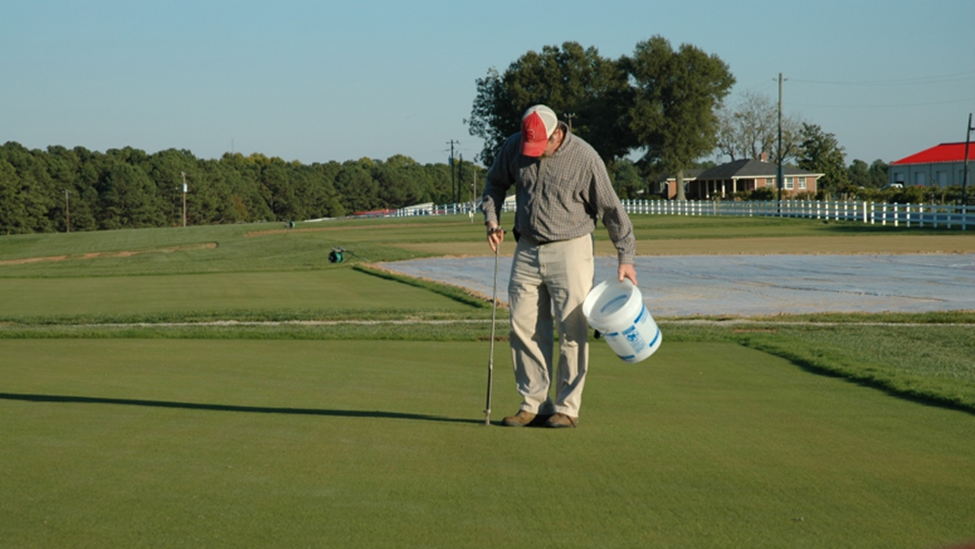
Working with a nematode lab
The nematode lab will extract and count the number of each nematode species per volume of soil. These numbers are then compared to “damage” or “action” thresholds established for each nematode species. If the population is above the threshold, turf is more likely to benefit from a nematicide application. If the population is below the threshold, a nematicide application is less likely to be beneficial.
The phrases “more likely” and “less likely” are used intentionally, as assay results do not necessarily provide a definitive diagnosis. Thresholds are a rough guideline, and how many nematodes your turf can tolerate depends on other factors like growing conditions, management inputs, and other stresses.
Treating for nematodes
If the nematode lab recommends a nematicide application, selecting the right product is an important next step. Gone are the days of nematicides that control every nematode species (and most other living things too). Today’s nematicides vary in their control spectrum and which nematodes they control most effectively.
Trefinti® provides excellent control of sting, root knot, lance and Anguina nematodes. The spot-treatment rate of 1.2 L/ha is recommended when nematode populations are very high or if the turf is showing signs of nematode damage. Trefinti® should be applied with a soil surfactant (either together or separately) and watered-in immediately with at least 3 mm. for best results.
Broad-spectrum nematode control
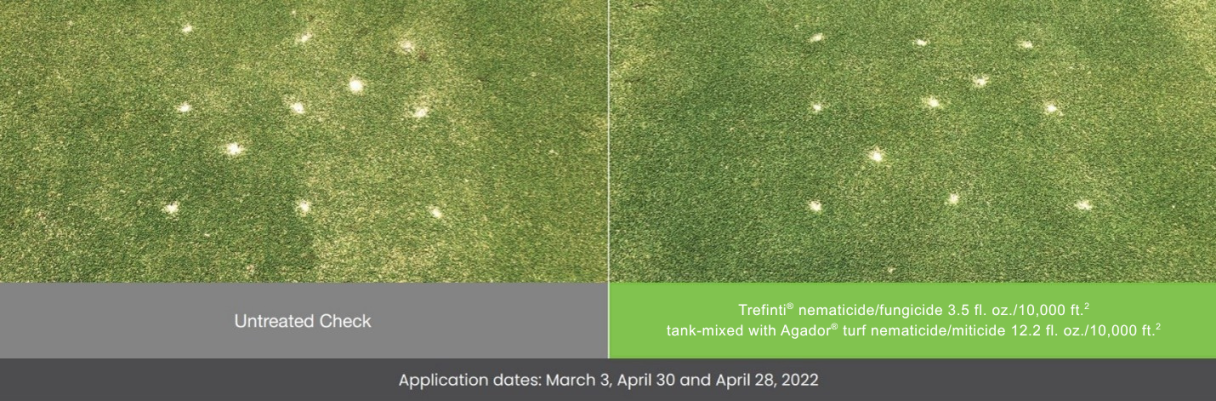
Agador® is the best option for curative treatments if root knot, stubby root or stunt nematodes are of primary concern. The spot-treatment rate of 3.5 L/ha should be used if populations are very high or if turf damage is already evident. For best results, Agador® should be tank-mixed with a soil surfactant and watered-in immediately with at least 3 mm. of irrigation.
How can you tell if a nematicide application worked? Monitoring for a response in turf health or rooting is the most reliable method to evaluate nematicide performance. Since nematode populations naturally fluctuate over time, nematode assay results are only a useful metric if an untreated area is sampled at the same time for comparison.
Note that if nematode populations are very high, repeating applications of Trefinti® or Agador® on a 28-day interval may be required to reduce assay numbers to below threshold values. Turf recovery can also take time, especially if growing conditions are not conducive or other cultural factors are limiting.
Managing root diseases in addition to nematodes
Root diseases like take-all root rot, mini ring, or Pythium root rot can also hamper recovery from nematode damage. The wounds created by nematodes are prone to infection by these root pathogens and many others. For this reason, we often see faster turf recovery when a nematicide and fungicide are applied together. With its dual action as a nematicide and fungicide, Trefinti® is a great option especially in warm-season grass where take-all root rot and mini ring are a common issue. If applying Agador®, consider tank mixing Agador® with a fungicide like Briskway®, Velista®, Heritage® Action™ or Posterity® fungicides.
Prevent nematodes with a program approach
Once the nematodes are under control, it is recommended to adopt a preventive program to protect the turf and maximize root growth going forward. Rotations of Trefinti® and Agador® are often recommended to control the broadest spectrum of nematodes and to prevent the development of nematicide resistance.