Agador + Heritage Action: Improve turf quality by preventing nematodes

Nematodes in Turfgrass: A hidden threat
Many types of plant parasitic nematodes can threaten turf quality by feeding on plant roots. Turfgrass roots with nematode damage are less capable of absorbing water and nutrients from the soil and require more frequent watering and are more susceptible to disease. As a result of nematode damage, turf may become chlorotic, wilt, thin out and die.
Did You Know?
There are 40 species of nematodes known to feed on turfgrass roots.
Nematodes occur in every soil type but are most prevalent in sandy soils.
Nematode damage is often mistaken for other issues such as drought, disease, and nutrient deficiencies.
Differences in feeding habits and mobility among nematode species can impact nematode counts and nematicide efficacy.
Anguina pacificae is the only Anguina species that forms galls on the crowns of infected plants.
The only way to accurately diagnose nematode damage is through a soil sample analysis.
Importance of Proper Nematode Sampling
Golf courses across Singapore are susceptible to nematodes, regardless of their soil type, and their turf may have suffered root damage because of nematode feeding. It is important for every course to properly scout for nematodes by taking soil samples and having them analyzed by a reputable lab.
Developing a nematode prevention program
Nematode and Disease Control
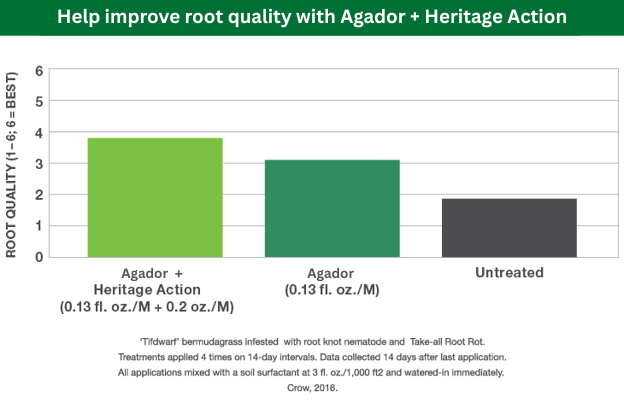
Nematodes weaken turf root systems, decreasing the plant's ability to defend against biotic and abiotic stressors like heat, drought and disease. Combining Agador® with Heritage® Action™ fungicide can help manage nematodes, diseases and abiotic stressors and prevent the onset of resistance. Heritage® Action™ delivers hybrid technology that couples the proven disease control of Heritage fungicide with a boost of acibenzolar-S-methyl (ASM) for enhanced biotic and abiotic stress management.
Agador® + Heritage® Action™ is designed to help prevent troublesome nematodes and boost turf’s natural defenses. With activity against all major root-feeding nematodes and Anguina pacificae, Agador® is an important foundation and rotation partner for any nematode prevention program.
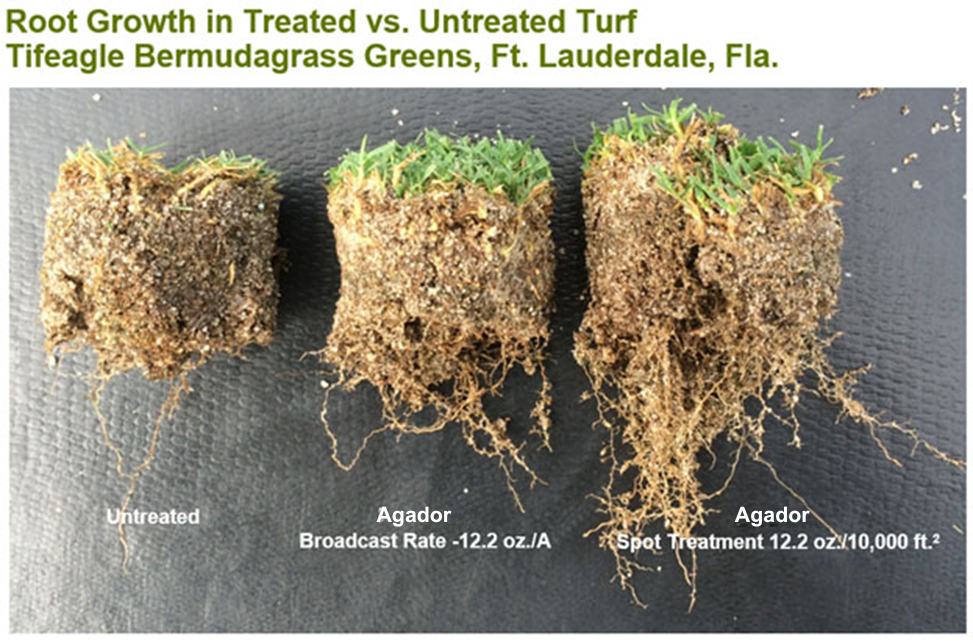
- Applications of Agador® protect new root growth from nematode feeding, enhancing overall turf quality and stress tolerance
- Make four applications on a 21- to 28-day interval when conditions are conducive to turfgrass root growth.
- In many cases, the application rate of Agador® (850 ml/ha) is recommended for preventive applications
- If sting, lance or spiral nematodes are above damage thresholds, apply the spot treatment rate of Agador® (3.8 L/ha)
- Anguina responds best to Agador® at 14-day intervals when symptoms first start to appear.
- Because turf roots damaged by nematodes are more susceptible to disease, Syngenta recommends the addition of a fungicide with a nematicide treatment to protect against diseases and abiotic stress
- These applications are often tank mixed and watered in with fungicides such as Velista®, Briskway® and Posterity fungicides to help prevent fairy ring and other root diseases
- All Agador® applications should be tank mixed with a soil surfactant and watered in immediately for best results
Enhanced biotic and abiotic stress management.
The disease-fighting effects of azoxystrobin combined with the plant performance benefits of ASM in Heritage® Action™ helps:
- Protect plant roots against diseases that can easily affect areas where nematodes have fed
- Improve the plant's natural defenses against abiotic stress like heat and drought
- Enhance turf quality of both warm and cool-season grasses for consistent playing conditions
- Increase drought tolerance through increased root function, more efficient transpiration and improved soil water retention
- Improve control of more than 20 diseases including anthracnose, patch disease, gray leaf spot and bacterial wilt suppression
Spot treatments
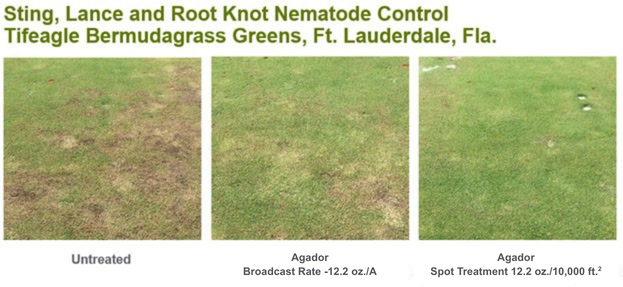
If nematode populations are very high or damage is already evident, Agador® can be applied to golf course turf at a spot treatment rate of 3.8 L/ha for improved control and enhanced turf quality.
Spot treatment applications of Agador® have been shown to:
- Stimulate more rapid turf recovery
- Reduce sting, lance, root-knot and spiral nematode populations
- Reduce damage to Poa annua putting greens from Anguina pacificae
- Spot treatments are limited to 10,000 ft.2/A and four applications per year
- They should be tank mixed with a soil surfactant and watered in immediately, just like with broadcast applications
- Begin with two applications on a 21- to 28-day interval and make additional applications as needed based on turf recovery, root growth and nematode populations
See the difference
While nematode assays are useful for making management decisions, they are generally not good tools to measure nematicide performance. Nematode populations fluctuate over time, increasing and decreasing with root growth and soil conditions. Furthermore, nematicide applications can lead to increased nematode populations in the long run, as more roots can support higher nematode populations.
The best way to evaluate nematicide performance is by:
- Assessing turf quality, root growth and stress tolerance
- If possible, leave an untreated area for comparison so you can see the impact of your nematicide program side by side