Get set for spring growth
Syngenta Technical Manager, Pete May, highlights how best to take advantage of any growing opportunities for surface recovery in a variable spring
Bridging the growth expectation gap
Spring hope and expectations are typically for strong turf growth and rapid recovery after the ravages of winter. In reality, it can prove one of the most challenging seasons for turf management.

And with the climate shift patterns, recent experiences show that early spring can be unseasonably warm and dry, or exceptionally wet and cold. Or worse still, a combination of both in the same season.
Over the past decade, February has been statistically the driest month on record, and the wettest month. We have also had the hottest March on record, and the coldest. This yo-yo effect of climate makes planning for spring activities harder than ever, at a time when players are expecting to get out on the course more frequently and expecting consistently better conditions.

Analysis of historic Growth Potential data for the past 30 years, on one site in southern England, as an example, shows that on the 1 March temperatures have ranged from -1.4⁰C up to 10.8⁰C, resulting in GP from 0% to 20%. By 1 May, the average daily temperature for the same site ranged from 6.6⁰C to 18.2⁰C, with the corresponding GP from 3% up to 100%, for the same day in different years.
Pinpointing the same data for just one year, from March to mid-May, in 2024, GP oscillated from 3% in early March, up to 46% by the end of the month and over 60% in early April, only to plumet back to less than 10% for two weeks in the middle of the month; before climbing to 98% in early May.
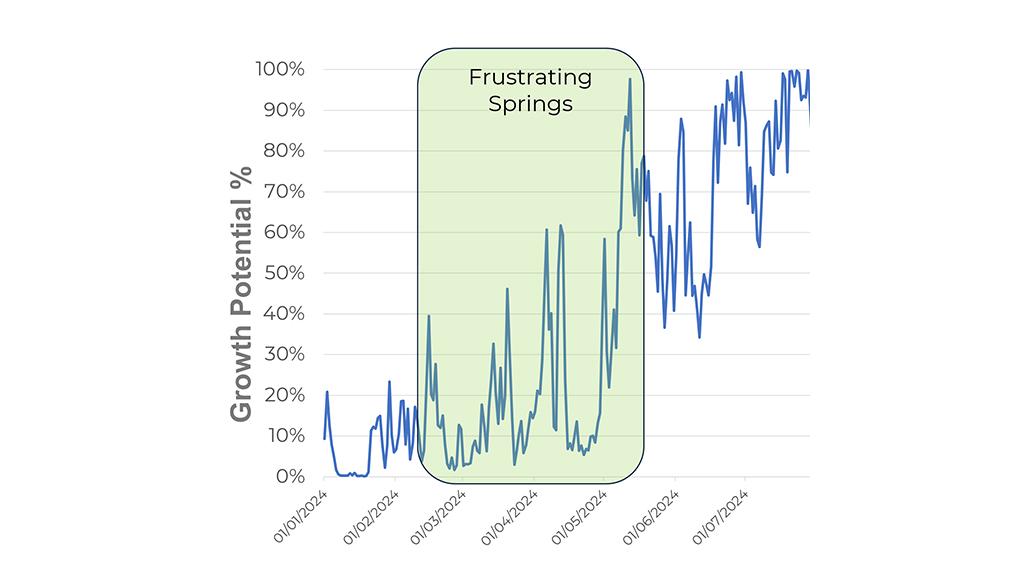
Despite the challenges of the huge variation, tracking Growth Potential and modelled forecasting is a still really good way plan programmes and to assess turf activity for opportunities to better time management actions to available recovery periods in the spring.
However, it is important to recognise that as a data model GP is using temperature as the driver for growth, when in practice moisture, light, nutrition and stress will all impact on the plant health and vigour.
Any actions to mitigate the limitations to plant growth will enable the plant to perform to its full whenever temperatures facilitate growth. The experience of recent years is that there are often periods of good conditions among more difficult times; the key is how to make the most of those recovery opportunities.
Reviewing the balance of Daily Light Integral (DLI) - the available light for plant photosynthesis - with a typical spring Growth Potential curve, clearly highlights that, for prolonged periods of the spring, plants have a shortfall of available light.
With light in short supply, it is important to retain as much leaf area as possible at this time of year. While it may be tempting to start squeezing down on mowing height to sharpen things up for the spring, leaving a slightly longer leaf will intercept significantly more light.
Furthermore, new research and understanding of plant genomics has shown the opportunity for selected biostimulants to enhance the light capture and photosynthetic activity of plants. Genome analysis of the new Syngenta biostimulant, Vyplenza, has identified a 53% uplift in gene activity responsible for light harvesting.
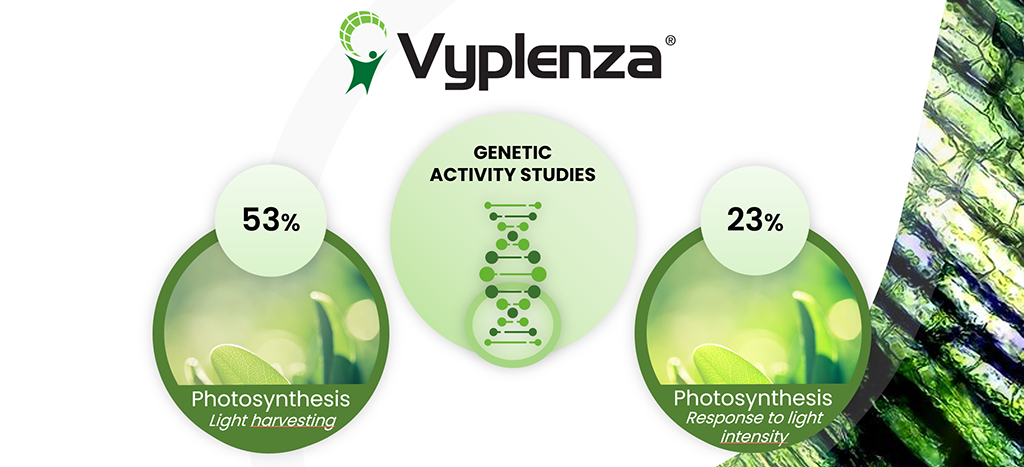
Through the spring period, and again in the autumn, this capability to make plants more efficient at utilising light and powering photosynthesis could make a significant contribution to enabling turf to reach its seasonal growth potential. That would also help to alleviate the associated stress that could make plants more susceptible to other damage.
Additionally, cutting back overhead vegetation to let more light penetrate to shady areas of greens and tees. Regular monitoring of light levels on the surface, using hand help meters, or more effectively continuous monitoring from remote light data loggers, can help to identify and quantify areas for action. Even light, and airflow, across the greens is essential to producing consistent playing surfaces.
Where the height of cut on greens is retained at winter levels for longer, that might mean utilising rolling more often. In addition to reducing the mechanical damage and stress of daily mowing, many greenkeepers are finding the practice can retain better green speed and consistency between cuts.

Increased use of rolling over the spring can be hugely beneficial in wet conditions, as well as to play a useful ITM role in early Dollar spot management. It can be most effective when used in conjunction with Primo Maxx II PGR strategies, to supress vertical leaf growth and maintain consistency.
One of the most frequent questions in spring is when to start the Primo Maxx II programmes. The combination of Growth Potential data and recording clipping yields – even as simple as the number of boxes from a reference green – is a great way to identify the onset of consistent growth and the optimum time to start. For initial application apply at half the rate that will be used for the full programme, to avoid stress and ease plants into PGR routine.
Once the programme is up and running, tracking Growth Degree Days is a useful tool to calculate PGR application intervals through the spring and summer. It’s worth noting that when using GDD to monitor product degradation and application timing, using a base of 0C will give more realistic results, compared to a 6⁰C base used when monitoring turf growth.
The reason being that degradation starts at 0⁰C, albeit more slowly than at warmer temperatures, so it is important to include those periods, especially in cooler parts of the spring or autumn season. The only difference in practice is that the threshold level will need to be adjusted down with the 0⁰C base, compared to 6⁰C – possibly using 130 to 150 as an interval, compared to 180 or 200 with a 6⁰C base. The optimum threshold you use should be evaluated for your individual site, but once established will give the most consistent results.
With the variability of rainfall frequently experienced in the spring, greenkeepers have frequently used a penetrant wetting agent in spring to dry soils out for early firmness, but if conditions all too often turn dry that could exacerbate the issue and prime soils for hydrophobicity early in the season.
It’s crucial to conserve moisture you have available in the spring while it is in the profile, rather than having to rewet dry soils using valuable irrigation resources that may be essential later in the season.
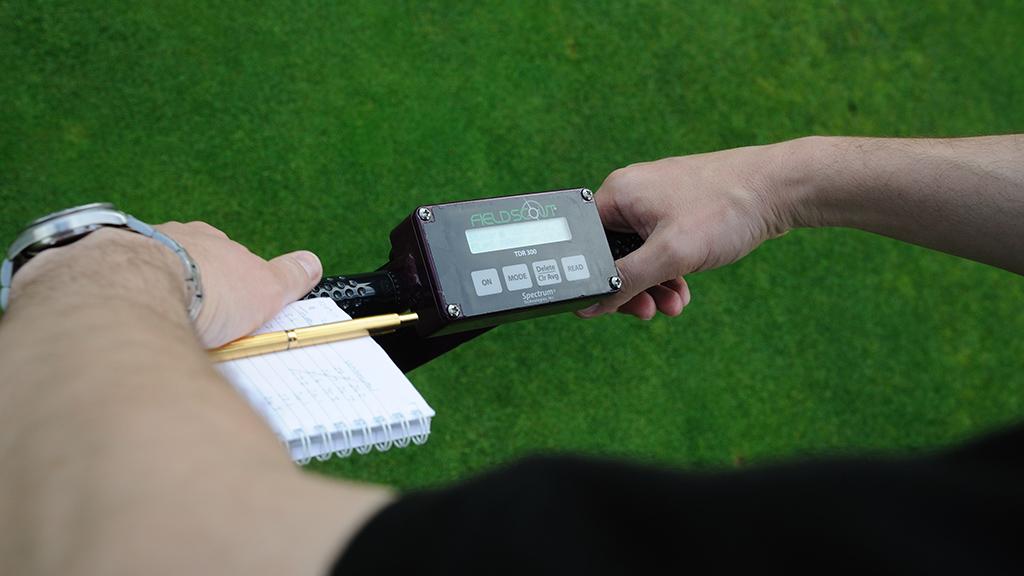
That is where the combination wetting agent, Qualibra, can have maximum effect - with a penetrant and retainer action to move water down from the surface, but hold moisture in the all-important lower profile for plant health and to promote strong rooting. Starting wetting agent programmes earlier in the season is well proven for optimising the use of existing water resources.
Ensuring sufficient nutrition is available to support early spring growth when conditions allow will be essential this season, especially since the heavy winter rainfall will have likely washed any residual nutrients out of the profile, particularly on sand construction greens.
One of the challenges of spring nutrition is timing to predict ahead of when the nutrients will be required, and the risk of loss if fertiliser is applied and no growth for uptake occurs
Providing a low level of readily available N in the form of quick uptake and utilisable amino acids, as in the biostimulant, Hicure, for example, can sustain growth until such a period of settled GP at 20%+ justifies the onset of the seasonal nutrition programme.
Many greenkeepers also look to benefit from the warm-up characteristics of Ryder pigment to help kick off early spring growth, as well as ensure the turf looks better for players coming out of the winter.
The combinations of innovative new biostimulant products, targeted at specific stress factors and enhancing turf health, now enable turf mangers to better take advantage of limited spring growth opportunities to boost recovery.