
Nordic lessons - Managing fairy ring and take-all patch
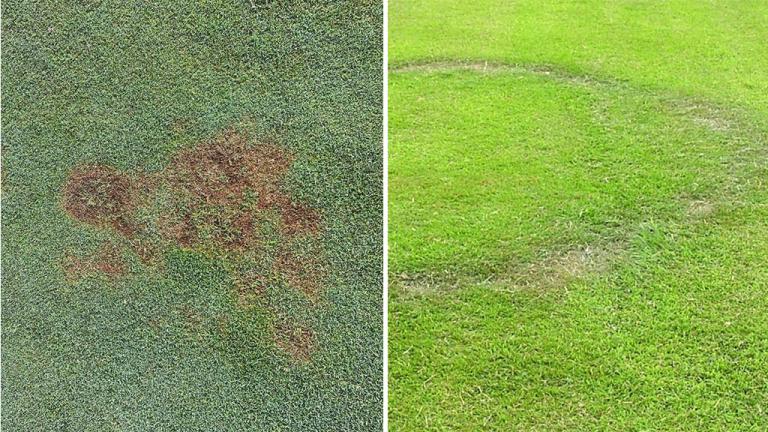
Syngenta Nordics Technical Manager, Alex Cawley, gives his insights and advice on how greenkeepers and turf mangers in the Nordics are managing fairy ring and take-all patch under intense disease pressure and extreme climate challenges. It provides valuable lessons into how these soil-borne pathogens could be better targeted under UK conditions, and an insight into the increased risks with climate shift.

As greenkeepers, we spend a significant amount of time and resources managing what we can see. But some of the most damaging threats to our greens are happening entirely out of sight, beneath the surface, long before any visible symptom appears.
Take-all patch and fairy ring are the two most challenging soil-borne pathogen problems we face in the Nordics and understanding how they behave — and where they overlap — is key to managing them effectively.
Take-all Patch — A view on what's out of 'sight'
Take-all patch, caused by the fungus Gaeumannomyces graminis, is a root-attacking pathogen. It colonises and destroys the root system of bentgrass species and occasional Poa annua. By the time you see the characteristic bronze to orange coloured patches appearing at the surface, the damage below ground is already extensive.
That reddish edge you sometimes see around a patch? That's a phosphorus deficiency — a direct consequence of a root system so severely compromised it can no longer take up nutrients effectively.
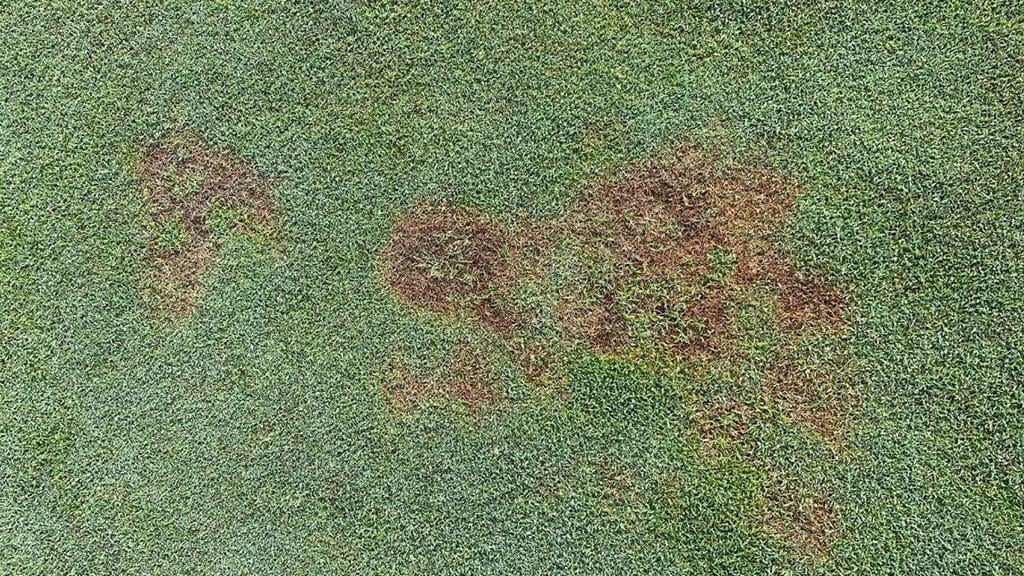
This is what makes it so ineffective to manage take-all patch reactively. Once symptoms are visible, preventative control is no longer an option. The window you need to target is when fungal cells are actively dividing — that is when well-timed fungicide applications can get the active ingredient exactly where it needs to be. Miss that window and your options narrow considerably.
Soil pH plays a critical role. The pathogen prefers alkaline conditions, and a root zone sitting at pH 7 or above creates a favourable environment for it. It can be a particularly damaging disease on newly constructed areas where root zone pH sits in the range favouring the disease. It is often stated that over time 'take-all decline' occurs, where soil biology develops having an antagonistic effect on how prolific the take-all pathogen can be. This can and often does occur but the pathogen can still re-appear under favourable conditions.
Acidifying nitrogen sources can be beneficial to use and can contribute towards acidifying rootzone areas the pathogen occupies, thus making the environmental conditions less favourable. The pH range of 6.0–6.4 represents the sweet spot for suppressing take-all patch disease activity. Using a wetting agent programme to help maintain a sensible level of moisture — not dry and absolutely not too wet — is another maintenance regime that can form part of a holistic approach to minimising the negative effects of the disease.

A characteristic of G. graminis is that, to help create an environment that promotes its own growth, it oxidises manganese — making it unavailable to the plant — a trace element that is critical for plant survival. Mn in grass plays an important role in photosynthesis and deficiencies cause growth suppression and eventually death. It also plays a role in defence and phytoalexin production. Front-loading manganese in spring through small, regular foliar applications is a strategy worth building into your programme as a proactive measure.
Take-all patch doesn't announce itself at the moment the damage is being done. By the time symptoms are visible at the surface, the root system has already been compromised — sometimes for several weeks. There is more than one way this plays out, and understanding the different pathways helps explain why flare-ups can appear at unexpected points in the season.
| Different climatic scenarios in through the season can give rise to different ways that take-all patch develops and its implications on turf surfaces: |
| Warm spring with good growing conditions: The pathogen is active during the 11–13°C development 'sweet spot' window and causes meaningful root damage before temperatures push it into dormancy above 14°C. The plant looks fine through this period. Then heat and drought arrive, abiotic stress increases, and with no healthy root system to draw on, symptoms appear suddenly at the surface — sometimes initially mistaken for drought stress. |
| Wet spring that stays wet: Persistently moist conditions give the pathogen an extended, largely unchecked run through the root zone. The surface looks normal throughout. When conditions dry out and warm up, symptoms can be severe and rapid — the result of damage that accumulated invisibly over weeks of moist favourable conditions below the surface. |
| Late-season flare after significant rain: A pathogen that didn't get a long enough window to develop in spring may not cause severe early-season symptoms. But a sustained wet period later in summer or early autumn can cool soil temperatures back into the activity range, and allow a second phase of root damage. If heat and drought follow, symptoms appear after heavy rainfall — a delayed presentation that can catch managers off guard. |
What these scenarios share is a disconnect between when the disease is active and when it becomes visible. Waiting for symptoms before acting means the window for effective intervention has already passed. This is precisely why temperature-based, preventative timing works — targeting the pathogen during its active phase, before root damage accumulates, rather than responding to surface symptoms that reflect damage already done.
Fairy ring — A drive for suppression, not eradication
Fairy ring is a different challenge entirely. Caused by a wide range of basidiomycete fungi, it operates by breaking down organic matter in the soil and creating a hydrophobic zone through the release of water repellent mucilage that repels water and starves surrounding turf of moisture and nutrients. The result — rings, arcs, or patches of lush, depressed, or dead turf — is as much a symptom of physical and hydraulic disruption as it is of direct pathogenic attack.
It is important to be realistic: fairy ring is extremely difficult to eradicate. The realistic goal with fungicide programmes is significant suppression, not elimination. Extreme fluctuations in soil moisture can trigger fruiting body development and visible ring activity, which is why consistent moisture management through a quality wetting agent programme is one of the most important preventative tools available.
Fairy rings are categorised into three types based on how they present at the surface, and the distinction matters when it comes to management decisions.
Type 1 — Dry rot fairy ring: The most damaging and most difficult to manage. The causal fungi produce a dense, hydrophobic mycelium in the soil that actively repels water, causing severe localised dry patch.

The turf within or around the ring dies as a result of drought stress and potentially toxic by-products produced by the fungal mass. Symptoms include distinct arcs or rings of dead or severely stressed turf, often with a dark green stimulated zone at the outer edge caused by nitrogen release as the mycelium breaks down organic matter.
Type 2 — Stimulated growth ring: No turf death occurs, but a visible ring or arc of dark green, lush growth appears at the surface. This is again driven by nitrogen release from fungal activity in the soil.

Less damaging than Type 1 but visually disruptive, particularly on fine turf surfaces where uniformity is critical.
Type 3 — Fruiting body ring: The least damaging of the three. No turf death, no stimulated growth — simply a ring or arc of toadstools or mushrooms appearing at the surface.

The fungal activity remains largely superficial and the turf itself is largely unaffected, though fruiting bodies need to be removed promptly on playing surfaces.
Where the two problems converge
Both take-all patch and fairy ring are significantly enhanced by high soil moisture. This is sometimes overlooked — we tend to associate wet conditions with foliar diseases, but root-zone and soil-borne pathogens are equally dependent on favourable moisture environments to establish and spread.
This is also where a well-timed, combined approach becomes genuinely powerful. At 13°C soil temperature, a single application targeting both pathogens simultaneously becomes possible. Heritage, applied at this temperature threshold and mixed with a quality wetting agent, offers suppression of both take-all patch and fairy ring in one pass.
The wetting agent is not optional here — it ensures comprehensive product distribution through the profile and maximises contact with the target organisms. For thick mycelial mats associated with type 1 fairy ring, possible solid tining or hollow coring may be additionally required to ensure even and thorough penetration of the application.
The target zone for application is to get the products into the soi. Apply at sufficient water volume to minimise spray retention on the leaf - typically 800 l/ha or more. Where possible use the Syngenta XC 08 Soil nozzle, creating a higher proportion of large droplets designed to roll off the leaf and penetrate through to the soil surface. Irrigation as soon as possible after application will help to more spray down to the soil; typically 2 to 4 mm, but avoid overwatering that could result in pooling on the surface. Application in light drizzle or to a wet leaf surface can also be effective.
When treating whole greens or large areas, always check that all zones have reached the target temperature. Shaded areas, north-facing slopes, and greens with restricted airflow can lag by one or two degrees — enough to meaningfully reduce efficacy. In those situations, splitting the application is the right call.
An autumn wetting agent application to ensure good soil moisture distribution is in place heading into the new season, followed by programmed applications through the year, forms the backbone of a sound preventative programme for both diseases.
| Key takeaways for managing fairy ring and take-all patch soil borne pathogens: |
|
|
|
|
|
|