Humidity

Humidity is the amount of water held in the air. At cool temperatures that can manifest as fog or mist, where the water droplets coalesce. At warmer temperatures many more smaller droplets can be held suspended in the air; air at a temperature of 35⁰C can hold six times as much water compared to 5⁰C.
Meteorologically, humidity is measured as RH (Relative Humidity), which is a % of the maximum water holding capacity of the air at any given temperature.
Why is important for turf management?
Humidity has a huge bearing on leaf wetness, which is in itself one of the major drivers of most turf diseases.
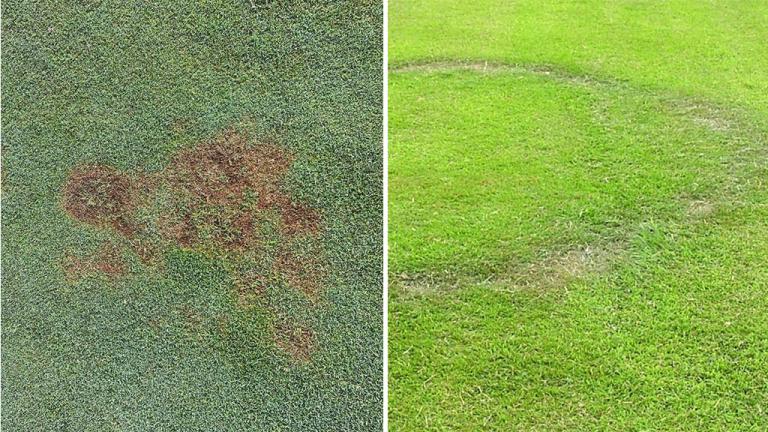
High humidity in warm temperatures creates the ideal conditions for most pathogens to develop, particularly microdochium patch in autumn/spring and dollar spot through late spring to early autumn.
Even when rainfall or modelled leaf wetness might appear to indicate low disease threat, high levels of humidity can be sufficiently conducive as to pose a risk.
In high humidity conditions leaves may be slower to dry as the surface water cannot evaporate, particularly if air flow is limited.
What are the key warning numbers to look out for?
You need to be vigilant when humidity numbers start to exceed 85%.
What other factors should humidity be considered alongside?
Humidity is likely to be highest after periods of rainfall combined with warm air temperature and soil temperature. It can also be viewed in tandem with modelled leaf wetness to help assess risks. It should also be looked at in conjunction with evapotranspiration. Wind speed and direction will help to dissipate humidity.
Always refer to humidity whenever reviewing disease model data, since a high humidity when the models forecast low risk could still indicate disease could be active.
What are the limitations with weather-modelled humidity?
The humidity data in Turf Advisor does not take any account of irrigation, which could raise local humidity. On a local level tree shelter or topography may give rise to areas of higher humidity than the forecast would suggest. Local knowledge of areas susceptible to high humidity is essential to consider.