Autumn applications on target

Sprayer operation holds the key to getting the best possible results from any application. Fine tuning aspects of nozzle selection, water volume and speed will all influence the ability to hit the target, and retain the product where it can work most effectively.
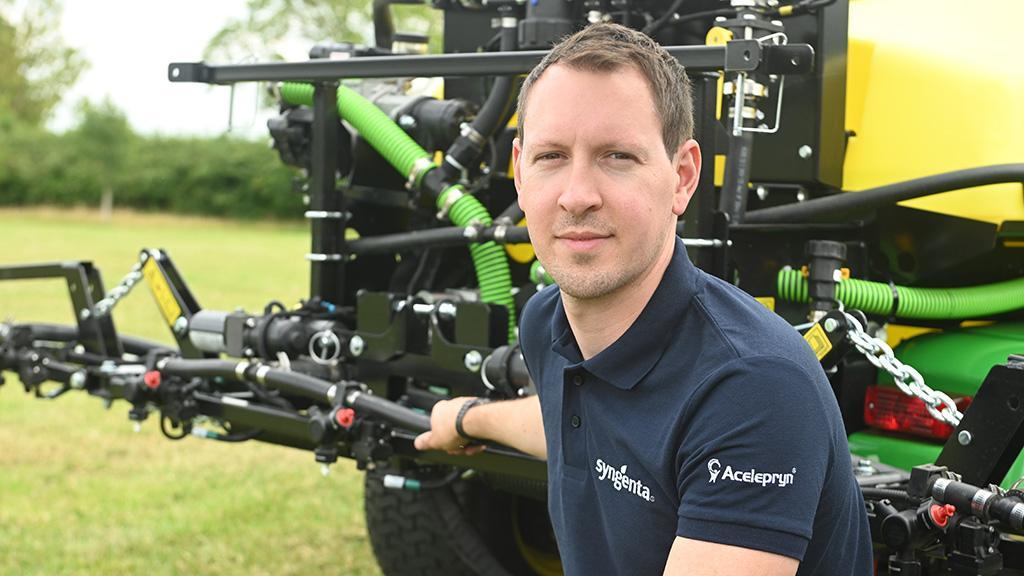
The challenge for autumn foliar fungicide application, is to get this balance between the spray droplet spectrum to achieve the desired coverage and retention on the leaf, along with managing the risk of spray drift, writes Syngenta Technical Manager, Sean Loakes.
The target leaf area on a green’s height of cut at just a few millimeters is very small, along with being very dense.
Leaf coverage is especially important with primarily contact fungicides. They work by preventing disease pathogens germinating on the surface and penetrating into the leaf. Formulation of the product is also important, to give an even coverage across the leaf as the spray dries and not leave gaps for the microscopic disease to get in.
Systemic fungicides that move into and around the plant to target disease ingress do give some greater flexibility, but are still best applied to get maximum retention on the leaf for faster uptake.
That is also a consideration with the autumn/winter fungicide programme, since systemic products require active plant growth to move around, while contact products are especially effective in cooler conditions, when growth is slow or stopped. Referring to Growth Degree Days (GDD) or Growth Potential (GP) in the Turf Advisor App can give a good indication of the optimum product selection during changing climatic and growing conditions.
Nozzle selection has a massive implication on application performance. It’s the point of delivery that actually governs consistency of spray across the surface.

Firstly, the size of the nozzle hole, orifice, will dictate the volume of water that passes through it at any given operating pressure. The water volume applied, and the spray pattern, are a balance between the nozzle size and operating pressure.
Most nozzles are designed to work optimally at a pressure of 2 to 3 bar.
You can use nozzles’ output chart to decide what size will best deliver close to your required water volume at 2.5 bar pressure and normal spraying speed, and then tweak that more specifically by adjusting the pressure or, better still, your speed.
Some nozzles are classified as variable pressure – or VP – that will still hold their pattern reasonably well as low as 1 bar or up to 4. That can be useful in particular instances, such as temporarily lowering pressure to reduce drift in an exposed area of the course, but it is still best practice to try and stick at around 2.0-2.5 bar.
For example, a purple 025 Nozzle would apply 246 l/ha operating at 2.0 bar when spraying at 4 km/hr, for optimum foliar application on greens. While an 04 nozzle at 2.0 bar would give the same output at 6.4 km/hr, more appropriate for application on fairways. Using a speedometer app on a mobile phone can conveniently and accurately monitor forward speed when spraying.
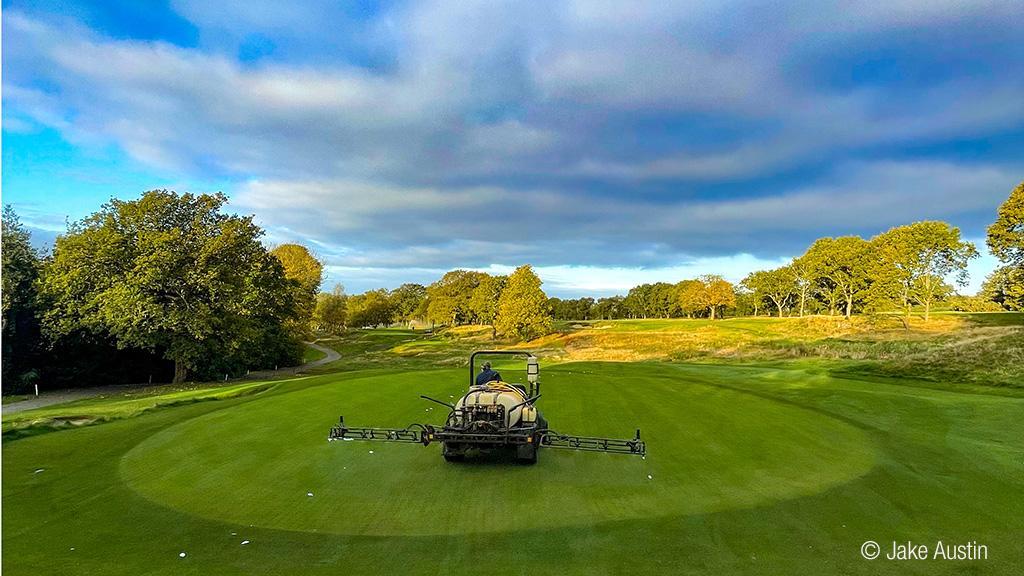
If your target water volume is, in the above case, 250 l/ha, it may be more convenient, and ultimately accurate, to slightly adjust that to a water volume that best meets a simple operation; using 243 litres of water + 3 litres of Ascernity would most accurately cover a hectare treatment at 2.0 bar and 4.0 km/hr when using an 025 nozzle.
The Syngenta Turf website has a whole series of free and easy to use sprayer calculators, in conjunction with nozzle output charts, to work out how you need to adjust pressure and speed combinations that will deliver precise water volume applications.
Nozzle selection will also dictate the size of droplets produced and the spray pattern. All nozzles produce a spectrum of droplets, from very fine to very coarse. However, smaller nozzle sizes produce a far higher proportion of fine droplets, and larger nozzles more coarse droplets.

Some newer nozzle designs produce a greater proportion of their droplets at a more consistent size, with fewer very small or very large droplets in the spectrum – which does make it easier to manage the spray pattern and match it to the target. If you are looking at nozzle specification, the range of droplet sizes produced is typically shown by the coefficient of variation.
Each time the diameter of the droplet halves, you get eight times the number of droplets per ml.
At higher operating pressures any nozzle will produce a greater proportion of finer droplets, as well as forcing more water through the outlet and increasing the water volume application rate. That could be either useful, or extremely detrimental, depending on what you want to achieve.
It can be especially crucial to recognise when using sprayers with auto rate controllers – which automatically increase operating pressure as you speed up, to maintain a constant water application rate. It is super useful to be able to adjust speed when spraying complicated greens, but take care not to exceed the nozzles’ margins for operating pressure that could see the spray pattern affected and excess drift occurring.
It is important to know the droplet spectrum, since a higher number of small droplets per millilitre of spray will help to give better coverage of a leaf surface and will typically stick better on the leaf, compared to fewer larger droplets that will give lower coverage, and can bounce or roll off the leaf surface.
That is because larger droplets have greater kinetic energy and velocity when they leave the nozzle tip and plummet directly to the ground, which is a huge benefit in reducing sideways movement and potential drift. Small droplets, with limited energy, can be caught and by wind or air currents and moved around, so in anything but quite still conditions can be lost as drift.
That can frequently occur in turf applications, especially on tight cut tees and greens. As spray leaves the boom it creates a curtain of descending water droplets and air; essentially to reach the surface it has to move a corresponding volume of air out of the way. In fairways or rough, there is space for the air to move and dissipate so water droplets can reach the ground, but on a flat green there is greater resistance to the falling droplets. Large droplets with more energy can still reach the ground, but very fine droplets sometimes don’t have sufficient momentum to break through the air cushion and are left suspended in the air – rather like fog water droplets. That makes them highly susceptible to drift and movement away from the target. In application research trials up to 15% of the spray created as fine droplets has failed to even reach the target surface.
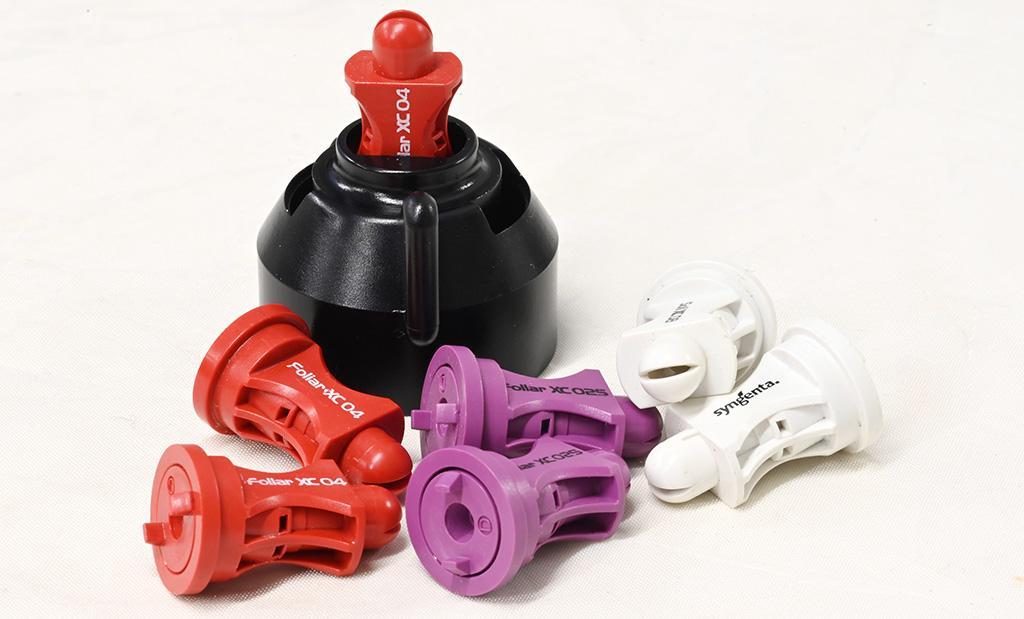
Syngenta XC nozzles have been specifically designed for turf applications, with a low coefficient of variation that produces consistently more droplets per ml in the desired spectrum at any size, compared to conventional or flat fan nozzles. That significantly helps in drift reduction in any conditions.
Furthermore, XC nozzles hold their pattern more effectively at varying heights; the sprayer boom should always be set at 50cm from nozzle tip to the target, but even if that drops to 30cm on undulating ground the XC nozzles will still give a relatively even spread, unlike conventional nozzles that results in over or under application and potential stripes of turf damage.
Another factor that will dictate nozzle size selection and operating speed will be the water volume to be applied. Historically many products for turf were tested, registered and applied at a water volume of 600 or up to 1000 litres/ha. Some older products were also advocated to be applied at high water volumes to minimise the risk of phytotoxic turf leaf scorch, or where they were being applied in conjunction with a liquid fertiliser.
The issue with high water volume is that it can effectively over wet the leaf surface and lead to high levels of run off. For a fungicide targeting soil pathogens, such as fairy ring, that could be a desirable benefit, but for most foliar applications, where the aim is to retain the product on the leaf surface, it could lead to significant losses.
Newer foliar fungicides have typically been tested and recommended at water volumes as low as 200-250 l/ha. That has advantages of improving the chance of retaining spray on the small turf leaf area, as well as enabling greater coverage per sprayer load that can reduce time spent filling and travelling, along with less weight carried on sprayers on the green.
To cover most turf applications, fitting a nozzle holder with low drift Syngenta XC nozzles of 025 (purple) – typically for foliar applications of fungicides, PGRs or herbicides on greens at low speeds; an 04 (red) – for foliar applications on fairways or semi-rough at higher speeds, and an 08 (white) for soil target applications, such as wetting agents, Acelepryn insecticide or nematodes.

Therein lies one of the major challenges for turf applications, where a tank-mix applied to save time and costs may have products with different targets and intentions. In which case, it is the operator’s decision to assess and select according to the most important priority for the application. If that is likely to compromise any one element too much, it may be more appropriate to make separate applications, using the best practice for each intended target.
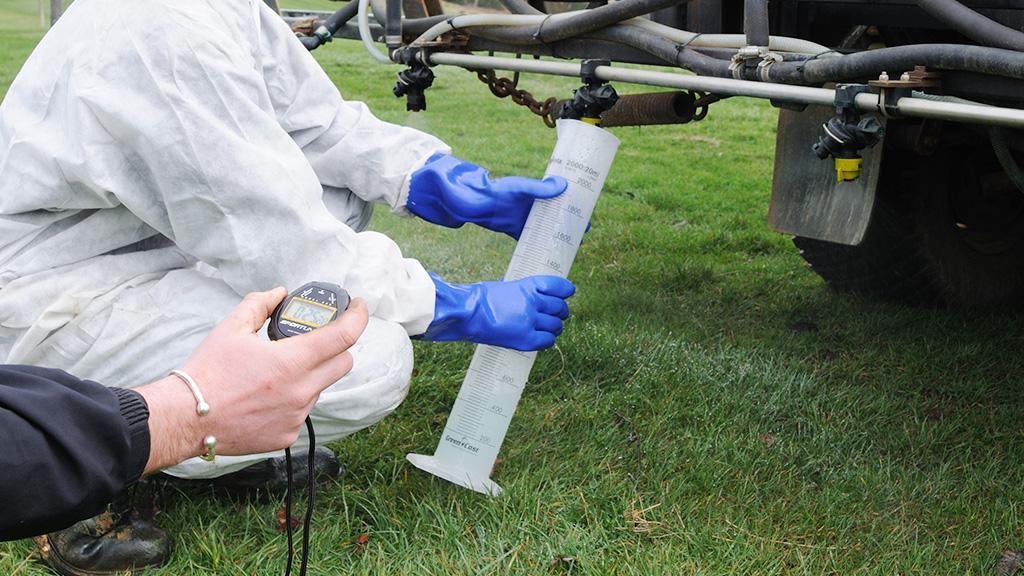
One further aspect of nozzle operation is to regularly clean check them for output and wear. With the sprayer filled with clean water, before adding any chemical, collect and record the output from each nozzle for 30 seconds with an accurate measuring cylinder. Calculate the average output per nozzle and if any nozzle deviates from the average by more than 5-10% it is a clear indication of wear that could compromise even coverage; the complete set of nozzles should be changed.
Most nozzles are now manufactured with robust materials that should resist wear, but the regular application of iron and trace element products, or some liquid fertilisers, can be especially abrasive and require more regular checks.
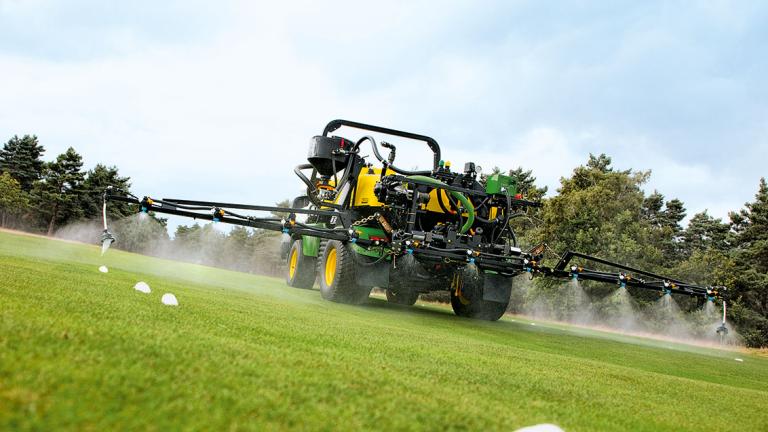
Once you have set the nozzle selection, water volume and speed in the yard, as well as calibrating and checking the machine for leaks and condition, operation on the course is equally important. Boom stability is very important to maintain even and consistent coverage, as well as reducing risk of drift. Operating at a slower speed helps with boom stability, as well as reducing turbulence behind the sprayer that can affect the spray pattern.
Although sprayer operation can appear onerous, an understanding of the objectives for the specific treatment and its intended target will help to decide the application techniques to get the best possible results.