


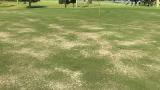
Take-All Patch
Gaeumannomyces graminis var. avenae and Gaeumannomyces graminis var. graminis
Turf Disease
Susceptible Turf
Seashore Paspalum, St. Augustine, Cowgrass, Zoysiagrass
Symptoms
- Affected turf appears to be thinning out and loss of density and typically do not recover quickly
- Irregularly shaped chlorotic patches up to 3' (1 m) in diameter, the lower leaves become chlorotic first, stolons and rhizomes turn off white to dark brown with possible black lesions, shortened root length that may also turn black and rot t
- Stressed grass appears bronze to reddish-brown and then fades to a dull brown.
- Less severely infected tissues often bear dark strands of mycelium oriented primarily parallel to the root axis.
Conditions Favouring Disease
- Conditions that are favorable for disease development include low light or shaded condition, warm-hot temperatures, and extended periods of rainfall in tropics
- Severe during cool, wet years and in poorly drained turf
- Greatly enhanced on turf grown in soils with high pH.
- Increasing acidity tends to suppress this disease.
- Soil conditions favouring the disease include, light texture, low organic content, low or unbalance fertility, soil pH above 6.3
Management Tips
- Use acidifying fertilisers.
- Apply moderate to high levels of phosphorous, potassium and minor elements where these nutrients are depleted from the soil.
- Improve drainage of turf.
- When liming apply the coarsest grades of lime to avoid rapid changes in pH.
- Removal of diseases patches and resodding where small areas are affected.
- Preventative systemic fungicide applications.
General Comments
Take-All Patch predominately affects high maintained turf area, mostly on the greens.