
Target search: Dynamic textarea
Filter your result
Filter
Back to filters
Target Category
Back to filters
Back to filters
Back to filters
Back to filters

Turf Disease
Anthracnose
Colletotrichum cereale
Find out more about this important turf pathogen, along with Integrated Turf Management measures to help control it: What is anthracnose?Anthracnose (Colletotrichum cereale) is a turf disease pathogen that can affect turf across the UK and Ireland. It is typically viewed as the second most common turf disease, after microdochium patch.Anthracnose can affect all turf species, but is most prevalent on Poa and Fescue grasses.The pathogen can result in two types of disease: foliar blight and basal rot.How do you spot and identify anthracnose?With foliar blight infection the grass turns a tan-yellow colour in irregular patches. It is often mistaken for drought in the summer, particularly since the stress induced by drought can be a significant trigger for anthracnose to break out. The presence of acervuli with hair-like setae is used to diagnose foliar blight under the microscope.Basal rot begins as yellowing of older leaves on individual plants. The youngest leaf may become brick…

Turf Disease
Brown Patch
Rhizoctonia solani
Brown patch occurs on close mown turf where patches of water soaked grass develop. The patches become tan to dark brown (Plate 1 above). In humid conditions a brown/grey 'smoke ring' may develop around the edge of the patch. On higher cut grass a light brown patch forms. Individual leaves may have lesions that are tan in the centre and bordered with a brown edge (Plate 4 above).Where is Brown Patch found?Brown Patch is not very common but it is most frequently seen on close mown areas such as golf greens and bowling greens. On longer grass lesions may be found by close inspection but it is rare to encounter patches of diseaseWhen is Brown Patch likely to attack turf?During the summer months, when the temperatures and humidity levels are high.Effects of Brown PatchBrown Patch reduces the aesthetic appearance of the turf. In severe cases grass cover may be lost in the patches.High Risk SituationsTemperatures over 20ºCLeaf wetness or high humidityPoor surface drainageExcessive fertilityITM SolutionsIntegrated…
Turf Pest
Chafer grubs
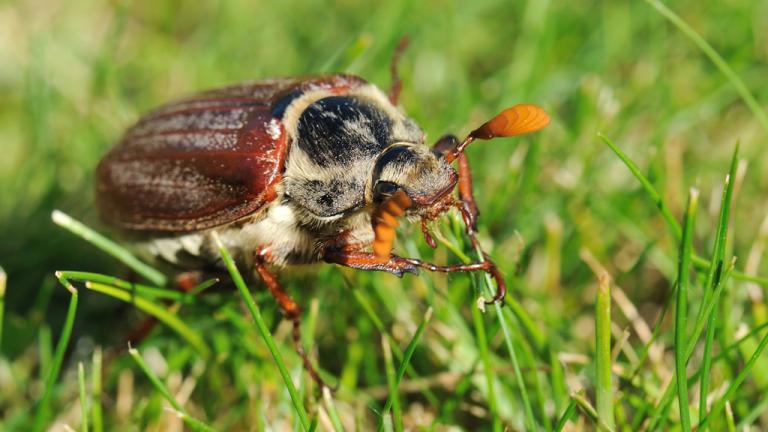
Find out more about these important turf pest, along with Turf Management measures to help control them: Garden chafer (Phyllopertha horticola) The garden chafer is the most common of the UK chafer species.With its greener and smaller appearance the adults are less noticeable, compared to cockchafer or summer chafer.Adults are typically less than 10 mm long, with brown/green wing cases and a bottle green head.Most often found in late May or June, depending on temperatures.Larvae emerge into adults over 10 days, frequently flying between 10 am and 12 am in sunny conditions.Eggs are laid in groups of 2-6 eggs 10 cm below the soil surface. Females will lay 10-50 eggs over a season.Garden chafer have a one-year lifecycle, with larvae quickly progressing through to third instar stage by autumn, to emerge the following summer. Larvae are smaller, up to 15 mm at emergence. Cockchafer – May bug (Melolontha melolontha) Cockchafer, or May bug, are the largest of the UK chafer species…
Turf Disease
Dollar spot
Clarireedia homoeocarpa
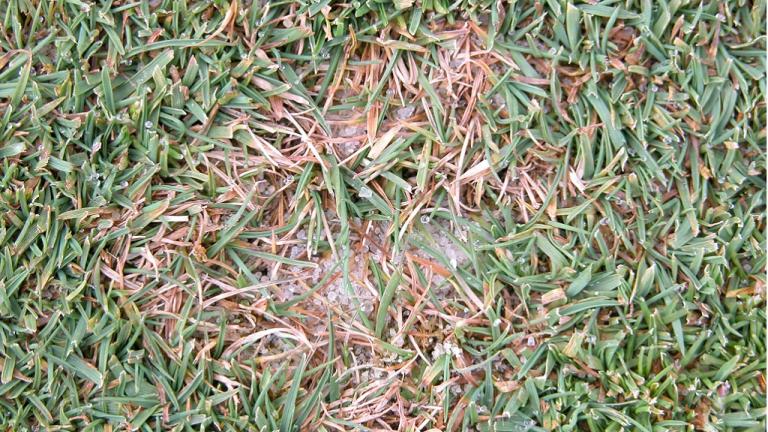
Dollar spot lesions on leaves are a pale, bleached colour. They are bound at either end by a darker reddish-brown band separating the affected tissue from the healthy green tissue. Small (dollar size) spots of bleached turf occur on close mown grass (Plate 3). The spots may coalesce to form large areas of affected turf (Plate 4). White mycelium may be present on affected areas on dewy mornings, which disappear as the leaves dry.Where is dollar spot found?Any area of turf, especially golf greens, tees, fairways and bowling greens. In the UK, fescue dominant swards are at high risk of infection. Poa annua grass can also be severely affected.When is dollar spot likely to attack turf?During the summer months, when the daytime temperatures are above 20ºC. Humid or thundery conditions can encourage an outbreak, as can heavy dews. Low fertility swards are at more risk from dollar spot.Find out more about dollar spot risk assessment with Turf Advisor Effects of dollar spotThe spots reduce the…
Turf Disease
Fairy Rings
A group of fungi classified as basidiomycetes
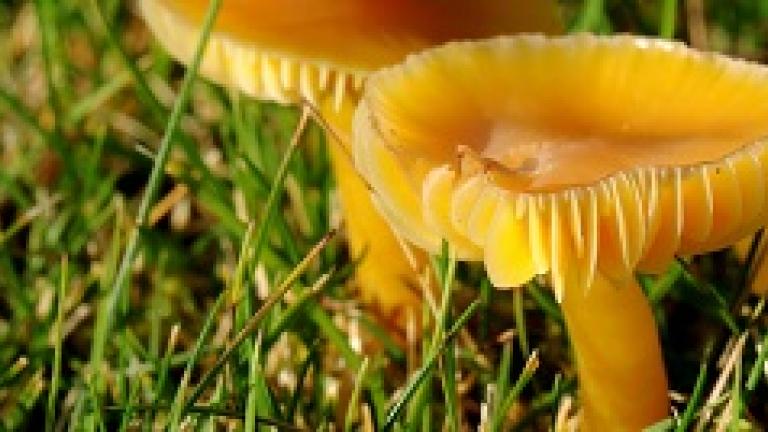
The term 'fairy ring' is used to describe a number of turf grass diseases where soil-borne fungi cause certain symptoms to develop on the surface of the sward. Fairy rings are caused by the activity of many fungi classified as basidiomycetes.Not all basidiomycete fungi cause fairy rings but all fairy rings are caused by basidiomycete fungi! Dry patch symptoms on fine turf areas are also thought to be associated with basidiomycete fungi.Where is Fairy Ring found?Each of the individual fungi grow through the rootzone, feeding off the organic material as it increases in size. The effects seen on the turf surface are roughly correlated with the amount of fungal mycelium within the rootzone. Since the fungal mycelium is made up of compounds that naturally repel water (in the same way that our fingernails do), the more mycelium that is present, the more water that can be repelled by it. Therefore, the larger the amount of fungal mycelium, the more severe or noticeable the effect on the turf…
Turf Disease
Grey leaf spot
Pyricularia oryzae/grisea
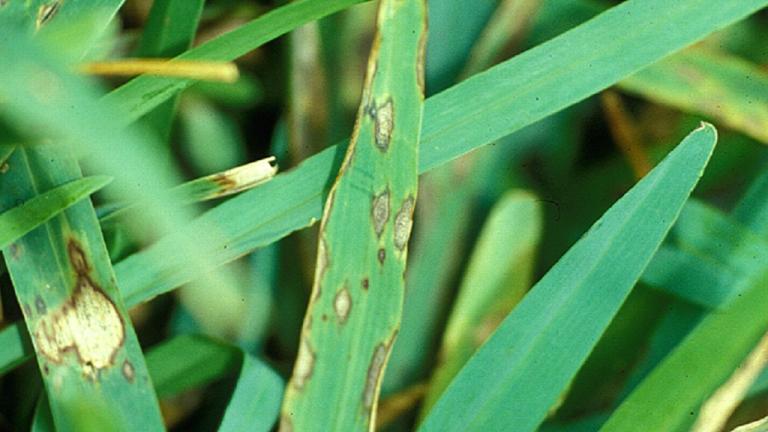
Where is grey leaf spot most likely to occur?Grey leaf spot has been widely identified in sports stadium and enclosed turf areas, where temperatures can be elevated and air flow limited, leading to high humidity conducive to the disease.As temperatures increase with prolonged periods of hot weather, grey leaf spot can be expected to occur on wider turf areas, including susceptible golf greens and tees.In what conditions does grey leaf spot break out?Grey leaf spot is most likely to occur during periods when leaves are wet for a long period of time, combined with an average temperature in excess of 20⁰C - which would typically occur with a daytime temperature in excess of 25⁰C and not falling below 15⁰C during the night.Periods of leaf wetness of more than nine hours at high temperatures, or over 20 hours at lower temperatures, create high risk situations. What other factors increase the risk of grey leaf spot? In addition temperature and leaf wetness, the damaging effects of…

Turf Disease
Leaf Spots
Bipolaris and Curvularia spp. Drechslera spp.
Symptoms depend on the grass species and the pathogen involved. Generally a yellowing or paling of the leaf blades may occur, accompanied with spots or lesions developing (Plate 1. Lesions may girdle the leaf and the portion above the girdle withers. The sward may thin or look drought stressed.Where is Leaf Spot found?Any area of turf, especially golf greens, tees, fairways, bowling greens, lawns, parks and sports pitches. All grass species can be affected by Leaf Spots.When is Leaf Spot likely to attack turf?During the summer months, when the temperatures are high. Humid conditions encourage outbreaks.Effects of Leaf SpotMinor infection may result in lesions on leaves but no other effects. Severe infection may thin the sward, cause dieback and leave patches with weak turf, affecting the aesthetic value and the playability of the turf.High Risk SituationsLeaf spots occur in mild and warm temperatures (around 20ºC). As the temperature increases (25 - 35ºC) blighting and melting out occurs.High fertilityMoist…

Turf Pest
Leatherjackets
Tipula paludosa
Crane fly (Daddy Long Legs) are the adult of the soil pest larvae, leatherjackets. Crane fly (Daddy Long Legs) are the adult of the soil pest larvae, leatherjackets.European crane fly - Tipula paludosa – is the most common in Britain, typically emerging in mid-August to mid-September, but can be later depending on soil conditions.A similar species, Tipula oleracea, also present but at lower numbers. It emerges and flies in May and June.Each female crane fly will lay up to 400 eggs, in small deposits of around six small brown eggs laid in numerous spots at the base of turf plants.Eggs typically hatch in 14 days, with larvae starting to feed.Leatherjacket larvae Crane fly eggs hatch after 14 days. The 1st instar larvae are around 0.3 cm long, growing to one cm after approximately one month - typically around November in the UK.Development continues through to a second and third instar stage, where it will overwinter deeper in the soil.In spring it moves back to the surface to continue…
Turf Disease
Microdochium Patch
Microdochium nivale
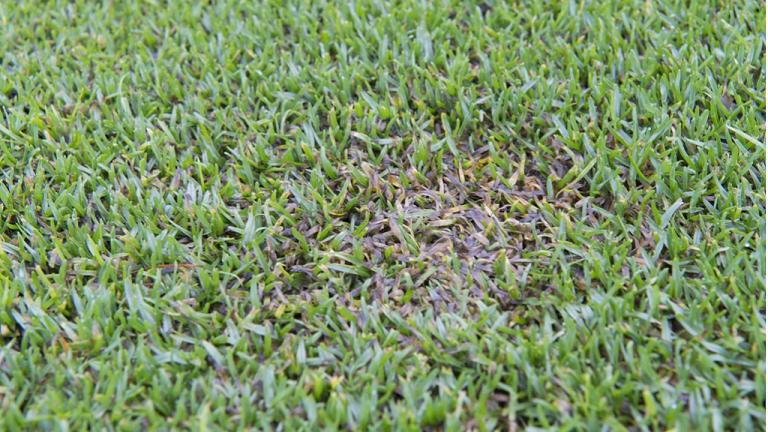
Microdochium Patch symptoms begin as a darkened water-soaked appearance to the grass (Plate 3). The patches enlarge and may develop salmon-pink to orange-brown rings of conidia around the outside of the patch (Plate 2). In conducive weather conditions, white, pink or grey mycelia may grow over the patch surface.Find out more about the latest microdochium disease risks for turf, and how to manage the challenge this season. Where is Microdochium Patch found?Microdochium Patch is the most common and widespread disease at present in the UK and Ireland. It can be found on any area of turf, especially golf greens, tees, fairways and bowling greens. Grass swards dominant in Poa annua are the most susceptible grass species to attack.When is Microdochium Patch likely to attack turf?Infections of Microdochium Patch can occur at any time of the year during conducive weather conditions. It is most common and damaging during the autumn and winter, when the weather is mild and…

Turf Disease
Red Thread
Laetisaria fuciformis
Turf Disease
Seedling Diseases
Microdochium nivale. Fusarium spp. Pythium spp. Drechslera spp. Bipolaris sorokiniana (Sacc.) Rhizoctonia spp.
Three types of seedling disease may occur:Seed rot, where the seed fails to germinate.Pre-emergence damping off where the seed germinates but fails to emerge.Post-emergence damping off where the seedling emerges but fails to establish (Plate 1).Where are Seedling Diseases found?Any area that has been newly sown. All turfgrass species can be affected, although post-emergence damping off is most severe on Bentgrass, Fescue and Poa pratensis L.Effects of Seedling DiseasesA very thin sward may develop, allowing access for Poa annua grass seed germination and contamination of the final sward.High Risk SituationsDry conditions favour Fusarium spp.Wet conditions favour Pythium spp.Inadequate or excessive seedbed fertiliser.Sowing during poor weather conditions.Poorly prepared seedbed.Integrated Turf Management SolutionsGood seedbed preparation.An appropriate rate of seedbed fertiliser should be used.An appropriate rate of high quality grass seed should be used and sown…

Turf Disease
Take All Patch
Gaeumannomyces graminis
Take-all patch symptoms begin as a slight reddening or bronzing of bentgrass usually in a ring during summer months (Plate 1). As the bentgrass dies resistant grass species or broad-leaved weeds invade the centre of the patch (Plate 4). Patches can measure from a few centimetres in diameter to over a metre. Symptoms may fade in late autumn and winter.Where is Take-All Patch found?Swards dominant in bentgrassIn most cases, take-all patch affects newly established areas (especially on sand or USGA specification constructions or areas that have been sterilised prior to establishment).Some golf courses have problems with take-all patch year after year. This is usually associated with alkaline irrigation water or rootzones with high alkaline buffering capacity.When is Take-All Patch likely to attack turf?Symptoms are most common during summer months and tend to fade out during winter months.Effects of Take-All PatchOn greens, take-all patch can affect the playing quality as the patches become depressed affecting…