Rooting resilience for healthy turf

Turf roots are hugely important in creating more resilient plants that are better able to cope with challenges of climate and the stresses imposed by managing high quality surfaces all year around.

Root mass is critical to turf survival. And while there are plenty of greens managed a 2 – 3 mm height of cut with just 10mm to 25mm of root depth, managing such greens leaves minimal margin for error, writes Syngenta Technical Manager, Sean Loakes. If anything unbalances the system, impacts can be instant and catastrophic.
The potential risks are becoming increasingly challenging as climate change imposes greater extremes of conditions and stress that can rapidly affect turf health.
Greater rooting gives more resilience against the impacts of climate induced stress, as well as the reserves to recover faster and more effectively after the event. That buffer is essential to deal with extremes of water - too much or too little, temperature fluctuations or management actions, as well as mitigating the impact of leatherjacket or chafer grub feeding damage on root matter, for example.
Furthermore, greater root mass - and importantly root depth - can make more efficient use of inputs, such as nutrition and irrigation water. Making better use of scarce water resources or costly fertiliser is a crucial element of sustainable turf management.
There is also strong evidence that improved rooting and the associated build-up of carbohydrate reserves can enhance the overall health of turf that, as part of an Integrated Turf Management (ITM) strategy, will help to mitigate against some turf diseases and minimise fungicide applications.
Any ITM actions that serve to optimise the photosynthetic activity of the turf plant, or minimise the damaging effects of stress, will help to build root mass during periods of good growth, as well as reduce the seasonal loss of roots during difficult conditions.
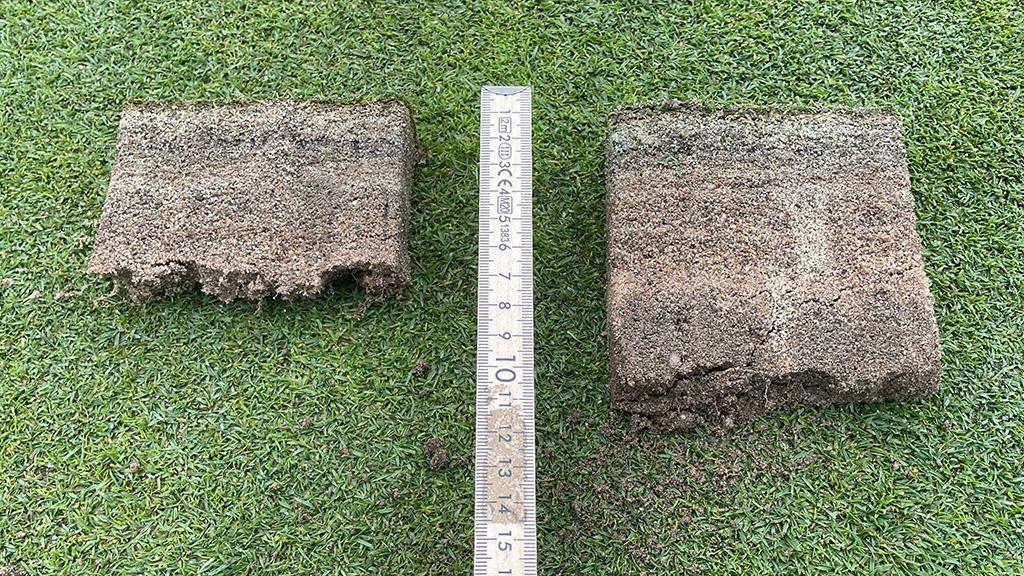
Golf course trials in the Nordics last year demonstrated up to 30 - 50% greater rooting with a season-long combination of Hicure biostimulant; Ryder pigment and Qualibra wetting agent, along with Primo Maxx II. Furthermore, despite extremely difficult weather conditions, turf surfaces recovered faster and required lower than expected N use.
One of the most serious effects of root die back is that it is the small end capillary roots that are typically shed first by the plant, and they are the roots that are most efficient at taking up water and nutrients from the soil.
Root depth is inevitably linked to height of cut - since it requires a certain level of photosynthetic activity to sustain turf growth and release spare energy, in the form of carbohydrates, to promote root growth. If the plant is not producing sufficient energy for growth, then it will draw on the root reserves to supplement that.
For example, turf will typically develop roots during growth surges in spring and late summer/autumn, but if heat and moisture stress imposes in mid-summer, root mass will decline to maintain health.

The smaller the leaf area, the less available energy for the plant. And if any other stresses are imposed on the plant’s ability to photosynthesize, the more it will be impacted. Some grass species are more susceptible to these stress effects.
| Top Tip checklist for root retention |
|
|
|
|
|
|
|
|
|
|
|
|
Extensive research has repeatedly demonstrated that turf in Primo Maxx II growth regulation remains fully photosynthetically active, but with less energy required for leaf growth there is typically additional free carbohydrate reserves within the turf plant.

Some of this carbohydrate is relocated to the crown to support greater lateral growth – increasing turf density and quality, while some is also available to increase the root mass. This is further strengthened by the promotion of cytokinin production, associated with enhanced lateral growth.
Trials on bentgrass in the US have shown a 28% increase in root mass during a two-month Primo Maxx II programme. Work in Texas also showed consistent improvements in assessed turf density with repeated applications, averaging 40% more over the course of the season’s research.
Furthermore, under summer stress pressure, when turf photochemical activity can be restricted and plants start to draw upon root reserves to maintain health, the additional free carbohydrates can crucially protect against the loss of root mass.
When turf is exposed to heat stress biostimulants can also help to alleviate the worst impacts on rooting and aid faster recovery, especially when the effects are prolonged – as is increasingly occurring with periods of climate change.
Research has shown that poa annua turf protected with Ryder pigment, prior to an extreme heat stress event at 28-30⁰C, had a 60% greater root mass, compared to untreated, even when kept fully irrigated to avoid drought stress. The result was associated with the increased chlorophyll level and over 40% improvement in photosynthetic activity with the treatment.
During the summer, the effects of anthracnose or, increasingly, dollar spot outbreaks will further compromise the plants’ ability to photosynthesize. Not only is there a direct loss in turf quality from the disease effects, but with increased draw on rooting its ability to recover can have serious consequences.
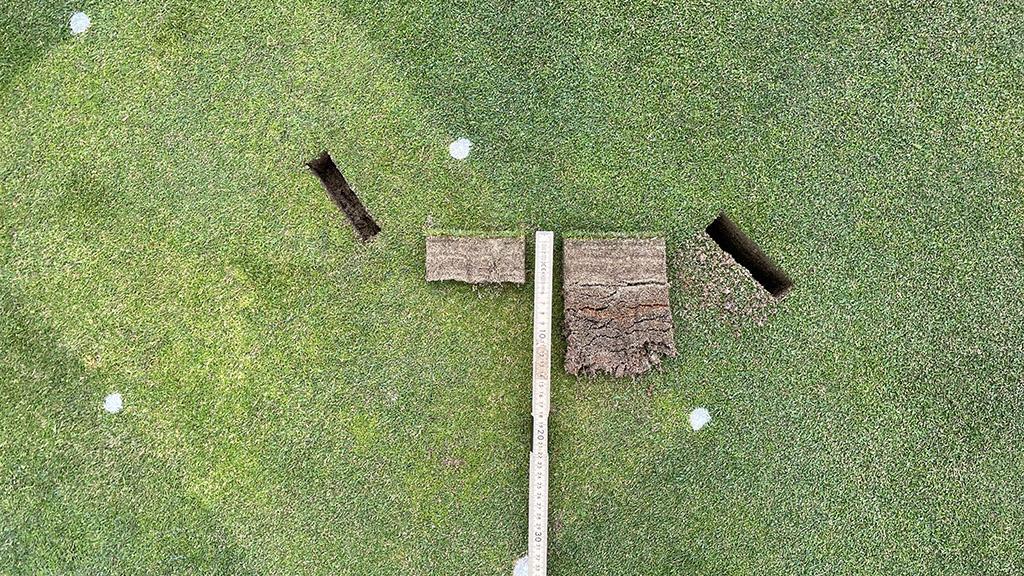
The benefits of root retention over the summer can have season long benefits. In the Nordics improved rooting and increased carbohydrate reserves in stronger turf plants have been attributed to significantly reduced impacts of late season microdochium patch disease and greatly enhanced winter survival.
Roots develop best wherever the conditions for their growth is optimal, which is primarily a factor of soil science and where the structure maintains a good balance of available air spaces and moisture.
Where the old adage was to dry soils down for playability, more importantly we should now be looking for consistency throughout the year to target root strength. Key to this is understanding the soil moisture more accurately, ideally through regular monitoring. That will enable appropriate management at the right time, to dry down or irrigation and wetting agents to maintain consistent soil moisture. The development of remote sensing in ground soil probes, to measure moisture and temperature, will help to guide decision making and timing in the future.

Effective wetting agent programmes have been shown to significantly enhance root mass and depth. A strategy that will move surface water down quickly ensures upper tier roots are not affected by lack of air spaces, which is crucial on turf with very limited root depth. While a wetting agent that can help to hold a balance of soil moisture at depth will enable greater root growth in that zone.

Trials in the development of Qualibra, combining a dynamic penetrant to move water from the surfaces and a powerful polymer to hold moisture evenly in the root zone, showed no increase in the top 6 cm of the soil profile after rain or irrigation, but a 21% enhancement at 6-8 cm and 17% at 10-12 cm, compared to untreated.
New Syngenta wetting agent research and monitoring, using remote sub-surface soil probes reporting real-time data of soil moisture and soil temperature, has identified exciting new products that can hold a better balance of moving water away through the profile during periods of wet weather, while retaining moisture at root zone depth during prolonged dry periods.
Retaining more consistent soil moisture with an effective wetting agent strategy improves plant health, along with preventing the build-up of dry patch for long-term root development.
Greenkeepers’ actions have to remain focused on maintaining high quality playability. However, today’s ITM strategies also now have to think more about what is going on under the surface, to retain stronger rooting that will build better resilience against a challenging climate.