
Filter your result
Filtreer
Back to filters
Target Category
Back to filters
Back to filters
Back to filters
Back to filters

Turf Disease
Anthracnose
Colletotrichum spp.
Anthracnose typically infects turfgrass, particulary Wintergrass during warm weather when the turfgrass canopy is wet and or humid.Susceptible TurfgrassesWintergrass, Bentgrass, Kentucky Bluegrasses, Fescue & Couch.SymptomsLeaves of infected plants turn yellow to a light tan to brown before dying.Younger leaves often turn red.Basel stem & leaf sheath's rot, affected plants are easy to pull out.Infected areas are seen as irregular shaped patches.Affected patches are a reddish brown colour turning yellow then tan to brown.A black stain may occur at the base of infected plants, this is an acervulus, a black fungal fruiting body Acervulus with setae visible with a microscopeConditions favouring diseaseDisease development is favoured by warm humid conditions.Anthracnose favours temperatures over 25°C.It is necessary for a film of moisture to be present on either the roots or foliage for infection to occur.More than 10 hours a day of leaf wetness for consecutive days.Hot summers in cool temperature…

Turf Pest
Black Maize Beetle
Heteronychus sanctae-helenae
LIFE CYCLE Eggs are white, oval in shape and measure approximately 1.8mm long. They are laid singly at a soil depth of 1 to 5cm. Females lay between 12 to 20 eggs in total.Eggs hatch after approximately 20 days. There are three larval instars. Larvae are creamy white except for the brown head capsule and hind segments of the abdomen, which appear dark gray/blue green, where the contents of the gut (plant roots and soil) show through the body wall. The head capsule is smooth, measuring 1.5 mm, 2.4 mm, and 4.0 mm at each respective instar. The third instar is approximately 25 mm long when fully developed. The larvae look very similar to many other beetle larvae, including dung beetles, and are therefore better distinguished by their activity. Most other beetles do not attack plants as larvae, so where root pruning can be observed, this is a good indication that black maize beetle larvae are present.Black maize beetle larvae are soil-dwelling and resemble white 'curl grubs’, with three pairs of…

Turf Disease
Brown Patch
Causal Agent: Rhizoctonia solaniSusceptible turfgrassAll species of warm- and cool-season turfgrass.SymptomsThe symptoms of brown patch can vary depending on the grass cultivar, climatic and atmospheric conditions, soil and intensity of the turfgrass management. This disease typically causes rings or patches of blighted turfgrass that measure between 12 cm and 3 m in diameter. It also causes leaf spots and "smoke rings"-thin, brown borders around the diseased patches that appear most frequently in the early morning.After the leaves die in the blighted area, new leaves can emerge from the surviving crowns. On wide-bladed species, leaf lesions develop with tan centers and dark brown to black margins. Conditions favouring diseaseBrown patch favours high relative humidity as well as temperatures of over 30°C during the day and over 15°C at night. This disease can be quite active at cool temperatures on warm-season grasses in the spring and autumn as temperatures in the…
Turf Disease
Brown Ring Patch / Waitea Patch
Rhizoctonia circinata var circinata
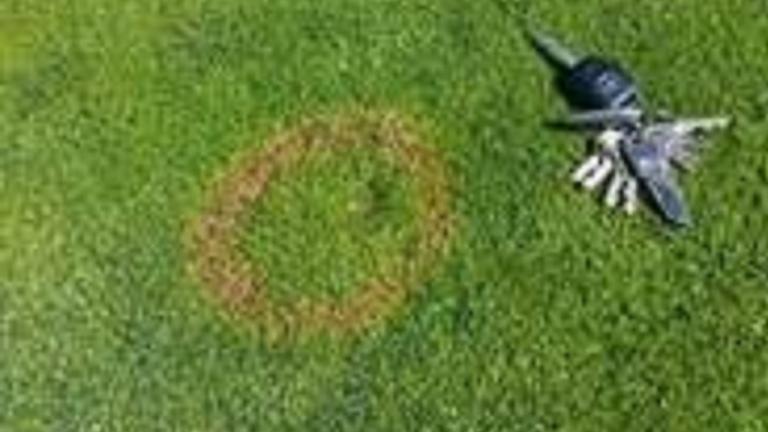
Brown ring patch is similar to other Rhizoctonia diseases, but does not react the same way to fungicides. It is a unique turfgrass disease that does not respond to management and environmental conditions in the same way as other diseases caused by R izoctonia.It is a disease that occurs in short-mowed annual bluegrass turf in cool, humid climates. Brown ring patch is often observed from early spring when annual bluegrass is breaking dormancy through to late spring. However, in cooler regions, it can be a problem during the summer when air temperatures range from 65 F to 95 F (18 C to 35 C).SymptomsTypically waitea patch begins as small, thin yellow rings with green grass in the centre. The rings can range from 10 - 30 cm in diameter. Rings may be circular or irregular in shape and may become oange or brown over time. In some cases the pathogen may even kill the turf. Patches often have a greenish colour behind the yellow…
Turf Disease
Dollar Spot
Sclerotinia homoeocarpa
Dollar spot causes sunken, circular patches that measure up to 5 cm in diameter on golf greens and several inches on higher mown turf. The patches turn from brown to straw colour and may eventually coalesce, forming irregularly shaped areas. Infected leaves may display small lesions that turn from yellow-green to straw colour with a reddish-brown border. The lesions can extend the full width of the leaf. Multiple lesions may occur on a single leaf blade. Dollar spots coalescing.Susceptible turfgrassAll species of warm and cool-season turfgrass.Conditions favouring diseaseDollar spot is favoured by temperatures between 15°C to 30°C and continuous high humidity.This disease is particularly favoured by warm days, cool nights and intense dews.It is more prevalent in areas with low levels of nitrogen and its effects are more severe in drier soils.Integrated turf managementUse an adequate level of nitrogen, particularly in the spring and early summer.Mow…

Turf Disease
Fading Out
Curvularia spp.
Susceptible turfgrass: Wintergrass, Kentucky bluegrass, bentgrass, fescue and couch. Curvularia leaf spotSymptomsIndividual leaves initially show yellow and green dapple patterns that extend downwards from the leaf tipInfected leaves turn brown, then grey as they shrivel and die.Irregular shaped patches of thinned turn appear, often coalescing to affect larger areas.Stolons and leaf sheaths may also rot.Conditions favouring diseaseCurvularia leaf spot occurs in areas that experience prolonged leaf wetness for several consecutive days.Curvularia spp. commonly occurs at temperatures, 25C to 35C.Soil compaction and excessive levels of nitrogen and thatch.General commentsCurvularia is mostly secondary disease after primary pathogens such as spring dead spot and Helminthosporium, have infected turfgrass.Physiological changes in the turfgrass plant can increase susceptibility to Curvalaria when the light intensity is low or when the mowing height is lower than recommended for the specific situation…

Turf Disease
Fairy Rings
Lycoperdon spp
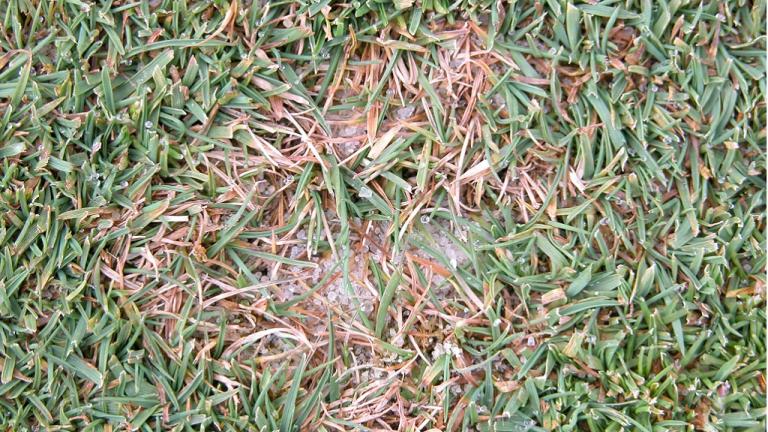
Caused by: Basidiomycetes of more than 50 species on native soils can cause fairy ring symptoms; some of the more common agents include: Agaricus campestris; Chorophyllum molybdites; Collybis spp.; Hygrocybe spp.; Lepiota spp.; Marasmius oreades; Bovista spp.; Scleroderma spp.; Tricholoma spp.; Lycoperdon clitocybe; Agrocybe spp.; Corprinus comatus; and other species.Fungal species occurring on sand-based greens are not as diverse, Lycoperdon spp is most common. Susceptible turfgrassAll species of warm- and cool-season turfgrass.DescriptionFairy ring symptoms vary with causal agents and the environment. Above-ground mushroom and puff ball basidiocarps may or may not occur. Typically, turf symptoms can appear as outer rings that are either dark-green or brown in colour. The symptoms may be hydrophobic rings or circular areas showing the first signs of wilt. The shape and size of the rings vary depending on the species and environmental conditions. Activity in the turf may subside when the…
Turf Disease
Grey Leaf Spot
Pyricularia grisea
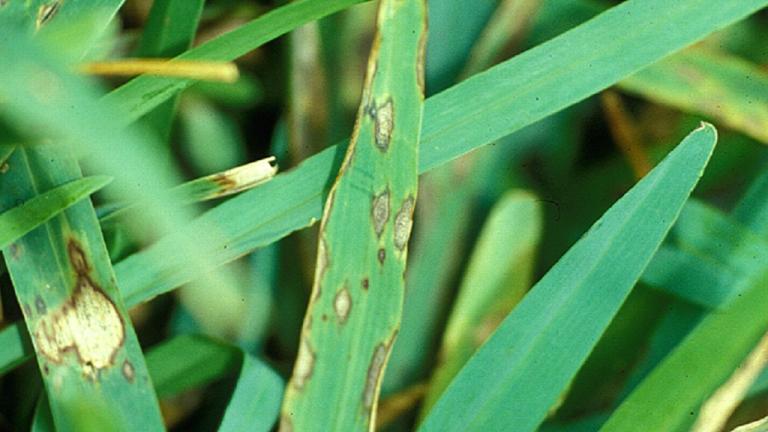
The symptoms of grey leaf spot vary depending on the grass cultivar. On St. Augustinegrass, grey leaf spot first appears as small, brown spots on the leaves and stems. The spots quickly enlarge to approximately 0.5 cm in length and become bluish-grey in colour and oval or elongated in shape. The mature lesions are tan to grey in colour and have depressed centers with irregular margins that are purple to brown in colour. On perennial ryegrass and tall fescue, symptoms first appear as small, water-soaked lesions that turn brown. Lesions may have a yellow halo. The leaf tips will have a twisted or fishhook shape.Conditions favouring diseaseGrey leaf spot favours temperatures between 26°C to 32°C. It is also found in areas with high nitrogen levels and that are stressed by various factors,including drought and soil compaction. This disease is most severe during extended hot and humid periods.Integrated turf managementAvoid medium to high nitrogen levels during mid-summer.Irrigate turf deeply and as…

Turf Pest
Insect Pests
Get preventative control of grubs, ants and juvenile mole crickets AFRICAN BLACK BEETLE IDENTIFICATION:Adults grow into 12 to 15 mm shiny black beetles. The males have a thickened tarsus on front leg (to help them dig). The grubs have distinctive orange spiracles along abdomen and thorax. Their raster is a transverse narrow slit (smiling grub). They are relatively inactive during winter, mate and lay eggs in spring (between 6 -12 eggs per female). Eggs incubate for generally 2 - 5 weeks dependent on soil temperature. Eggs hatch into 1st instar larvae. Larvae develop through 3 stages: 1st instar: feeds on decaying organics matter; 2nd instar: As they grow, they begin to feed on plant roots; 3rd instar: The larvae are fully grown larvae, about 25mm long. When the larvae are fully grown they build a chamber, then move into pre-pupae and pupae stages. The pupae develop into adults and emerge after about 2 months. Meridian has excellent efficacy on Black Maiz Beetle (1st and 2nd instar only). The best…
Turf Disease
Large Patch
Rhizoctonia solani
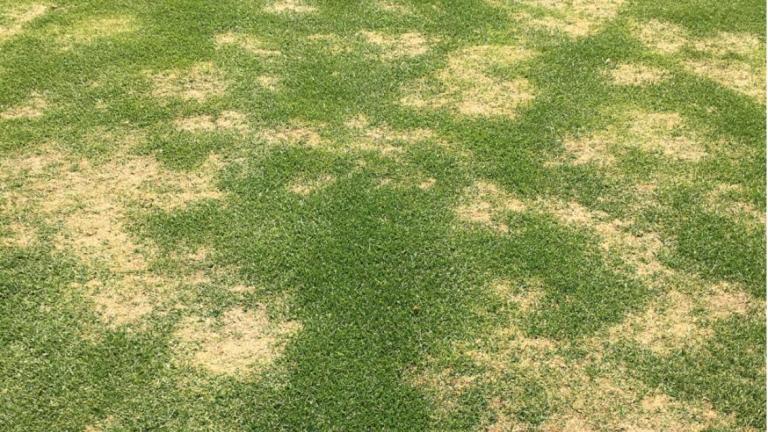
Large patch appears as rings or patches of blighted turfgrass that measure between 12 cm and 3 m across. Susceptible turfgrass:Kikuyu; seashore paspalum; zoysia grass and occasionally Bermuda grass.Symptoms:Large patch appears as rings or patches of blighted turfgrass that measure 12 cm to 3 m or more in diameter. Patches are brown to yellow in appearance, with a possible “orange firing” at the periphery of the patches. Small reddish-brown colored leaf spots occur on leaf sheaths, stems, and stolons. After the leaves die in the blighted area, new leaves can emerge from the surviving crowns. If the turfgrass is still green, the disease is most apparent down in the canopy, especially around the leaf sheaths as discolored/blackened lesions—when pulled lightly, these leaves detach very easily and are sometimes green above the damaged sheath.Conditions favoring disease:The symptoms of large patch vary depending on numerous factors…
Turf Disease
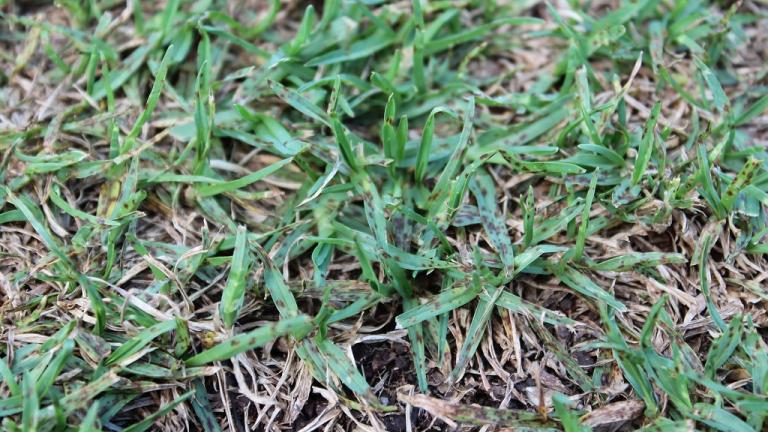
Leaf Spot / Melting-Out
Drechslera spp. and/or Bipolaris spp.
Susceptible turfgrasses: Creeping red fescue, Kentucky bluegrass, annual bluegrass, perennial ryegrass, tall fescue and some varieties of bentgrass and Bermuda grass. DescriptionLeaf spot (melting-out) causes purplish-brown to black spots with tan centers on the leaf blade and sheath. The lower leaves of the infected plants become shriveled and blighted. When melting-out infection is severe, almost all of the leaves and tillers die, causing severe thinning of the stand-or melting-out. On cool-weather turfgrass, melting-out typically follows the appearance of leaf spots.Conditions favouring diseaseLeaf spot is more commonly found when temperatures reach between 4°C and 26°C and in areas that experience more than 10 hours of foliar wetness daily for several days. It also favours high amounts of nitrogen and a low mowing height.Integrated turf managementIncrease the height of cut.Reduce turf stress by using lightweight equipment.Avoid the application of high rates of…
Turf Disease
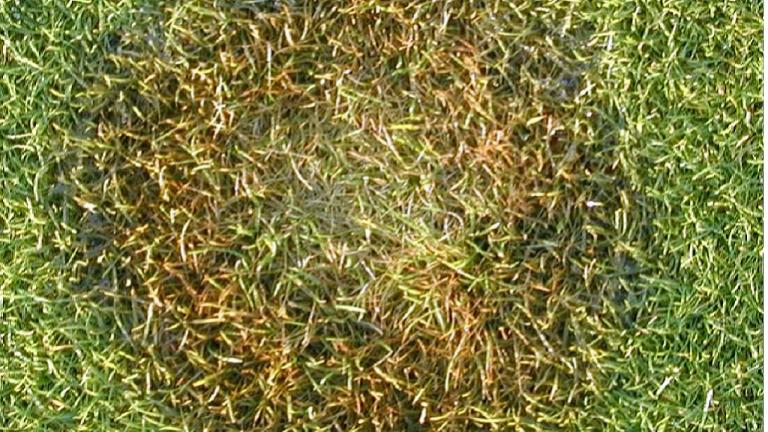
Microdochium Patch
Microdochium nivale (Fr.) Samuels and I.C. Hallett
Susceptible turfgrass: Bluegrass, fescue, bentgrass, couch and perennial ryegrass. SymptomsEarly water soaked circular spots (less than 5 cm).Colour changes orange brown - reddish brown - light grey or tan (no more than 20cm).Closer inspection reveals water soaked dark margins in active spots.May be confused with Pythium blight lesions.Streaks easily - mower / run-off water.Infection will rarely progress to crown or kill plants completely.Humid, cool conditions may see the development of white mycelial growth and ultimately pinkish sporodochia. Conditions favouring disease1 - 15ºC with free leaf moisture.Disease development speeded up dramatically after initial infection.Low humidity & higher temperatures slows development down.Most severe on poor drainage areas - higher mowed turf which becomes matted down.Disease severity enhanced by deficiencies in potassium and elevated nitrogen levels.Integrated turf managementMaintain adequate fertility levels especially potassium.Increased N in…