
Powdery Mildew
Susceptible turfgrass: Kentucky bluegrass, fine-leaf fescue, bentgrass, ryegrass, and Bermuda grass.
Symptoms
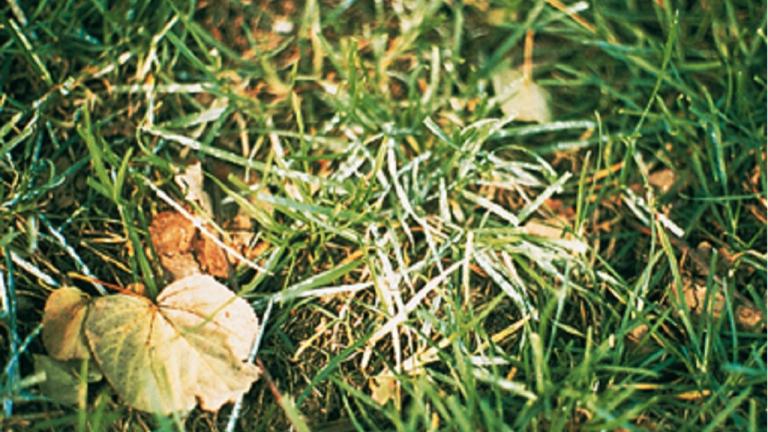
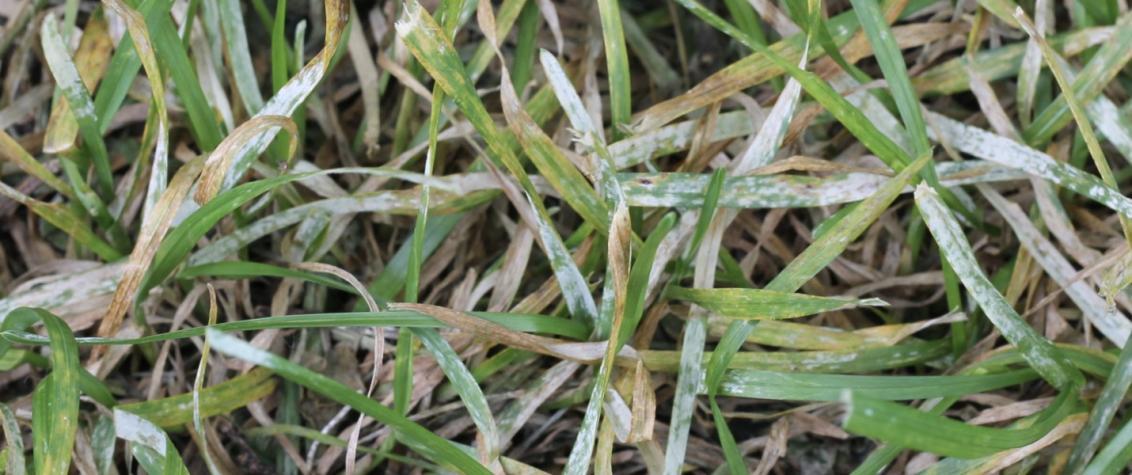
The disease first appears on the leaves as individual tufts of fine, white mycelium.
The tufts enlarge and coalesce, causing the leaves to have a greyish-white or powdery appearance.
Severely infected turf initially turns yellow, then tan and brown in colour.
Infected, shaded turf can become thinned, severe infection can result in turf necrosis.
Conditions favouring disease
Powdery mildew is favoured by humid, cloudy weather with temperatures between 15°C and 22°C.
It occurs in areas under stress, with low light, and with high humidity.
Powdery mildew is also common in areas with poor air circulation, but does not require a film of water to infect turf.
Integrated turf management
• Water to alleviate drought stress.
• Avoid high levels of nitrogen and irrigation that produce lush leaf growth.
• Raise the mower height.
• Prune tree limbs to improve air circulation and the amount of sunlight.
• Convert to a polystand of shade-adapted turfgrass.
Fungicidal Control
Banner Maxx has a label recommendation for powdery mildew in South Africa.