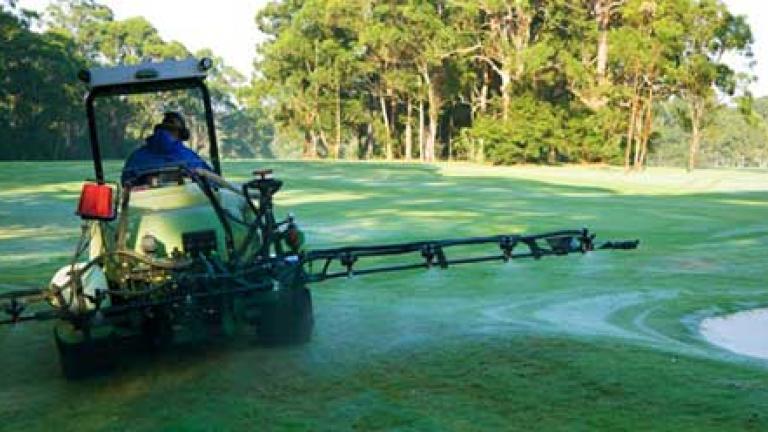
Engaging digital tools when using PRIMO® helps you make good turf great
By Michael Bradbery MA Ag. Turf – Technical Services Manager, Turf & Landscape ANZ
Whether you’re using PRIMO® 250EC or the improved version PRIMO MAXX® II to reduce mowing frequency or enhance plant health and surface uniformity you can rely on the consistent quality of Syngenta formulations.
PRIMO MAXX® II is an improved version of the original PRIMO® MAXX. Through independent side-by-side trials conducted both in Australia and internationally over several years, PRIMO MAXX® II has demonstrated equivalent growth regulation. While the new formulation contains a slightly lower active ingredient load (116 g/L vs. 120 g/L), it is specifically calibrated to deliver identical performance at the same application rates, ensuring ease of transition for users. Engaging Growing Degree Days (GDD) calculators and monitoring growth potential allows turf managers to adjust rates as required to ensure that maximum turf performance is achieved throughout the spring and summer.
Why Regulate Turf Growth?
The benefits of regulating turf growth, especially through summer are now well-established. These include:
Reduced mowing and clipping yield
Improved heat and drought tolerance
Denser, healthier turf structure
Enhanced root development
Better nutrient and water use efficiency
More consistent surface day to day and am to pm
Increased wear and shade tolerance
For those new the Growing Degree Days, click here
Rebound Growth & Target GDD Guidelines
Growing Degree Days are a powerful tool for determining the ideal timing of PRIMO® applications. Once the plant depletes the PRIMO® levels, it may exhibit rebound growth – a surge in leaf growth beyond normal levels. This can lead to:
Increased clipping volume
Greater plant wounding
Loss of pre-conditioning benefits (e.g. heat/drought tolerance)
Increase use of carbohydrate stored
GDD monitoring is used to avoid rebound from suppression. The following GDD targets are a commonly used starting guide:
Bentgrass/Poa Greens: ~200 GDD
Couch Grass / Longer Turf (Fairways, Ovals): ~250–300 GDD
These target GDD are refined by observing growth through methods like monitoring clipping yield to refine re-application timing. The goal being to sustain suppression with adequate clippings without rebound. Applying lower or half rates more often at lower GDD and overlapping suppression is common and covers for periods of poor weather or weekends to safeguard against rebound.
Monitoring GDD & Growth Potential
Many turf managers still calculate their GDD manually using the average of daily maximum and minimum temperatures less base temperature. The calculations provided on the web based Greencast services gives a more accurate representation of the days GDD. It uses hourly max and min temperature to take account for changing conditions during the day typical in coastal locations. Using your location you can access the previous 30 days GDD and accumulation.
Target thresholds can be set in Greencast Services with email alerts at 90% and 100% of target GDD.
Adjusting the level of suppression required for future growth will depend on forecast weather or Forecast Growth Potential which is available in the basic version of the Greencast Connect App (GCX).
Clipping Yield & Growth Potential
Monitoring and refining inputs using clipping yield has many benefits and potential savings. While it can be used to monitor and adjust your GDD targets it is also used to refine rates of PRIMO® used to conserve growth to ideal levels. Removing more clippings than necessary is a potential waste of resources. Consider also amount of Nitrogen applied in regard to clippings removed.
Calming the growth response or flat lining cool season greens in peak summer can enable the sustaining of excellent surfaces with less mower induced stress in extreme heat.
What Rate Should I Use?
In general start low and dial up rates through summer and back down for winter. Increasing or decreasing rate will not change the duration of suppression. If you desire greater suppression increase rates accordingly. For example, if the growth potential of Bentgrass is 50% when you apply a PGR but increases to 90% in the coming week the level of suppression won’t match the growth rate. That is why forecast growth potential is useful. If increased suppression is required (less clippings) more PRIMO® can be applied as required, but be aware of over suppression potential when stacking applications.
Special Considerations
Collar Areas Around Greens
Bentgrass collars cut at higher heights use less PRIMO® than greens, potentially leading to over-suppression. To avoid this:
Consider watering in collars after application
Or exclude collars from treatment
Use in Shaded Conditions
Shade and overcast conditions trigger a stress elongation response, thinning the turf and reducing carbohydrate stores.
Light Primo applications can reduce this stress, maintaining more functional foliage below the height of cut thus increasing photosynthetic efficiency
Conclusion
Using PRIMO MAXX® II effectively — guided by GDD, clipping yield, and growth potential forecasts — enables Turf Managers to maintain consistent, resilient, and healthy turf throughout the year.
Stay informed and stay in control with Syngenta Turf and GreenCast Connect.

Figure 1: Growth Potential as % Cool and Warm Season Turf on the GCX app.
Figure 2: Cool Season Growth Potential compared to 5 year average at top. Warm vs Cool Season 5 year average at bottom.
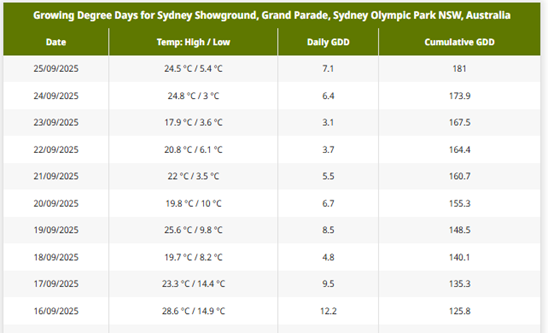
Figure 3: GDD for day and accumulated for previous 30 days from Greencast Services. Alerts can be set to get emails at 90% and 100% of target.
For more information visit www.syngentaturf.com.au or contact your local Territory Sales Manager.
Always read the label before use. Syngenta Australia Pty Ltd, Level 1, 2 Lyonpark Road, Macquarie Park NSW 2113. ABN 33 002 933 717. ®Registered trademark of Syngenta Group Company. All products written in uppercase are registered trademarks of a Syngenta Group Company. © 2025 Syngenta. ED 25-402.